


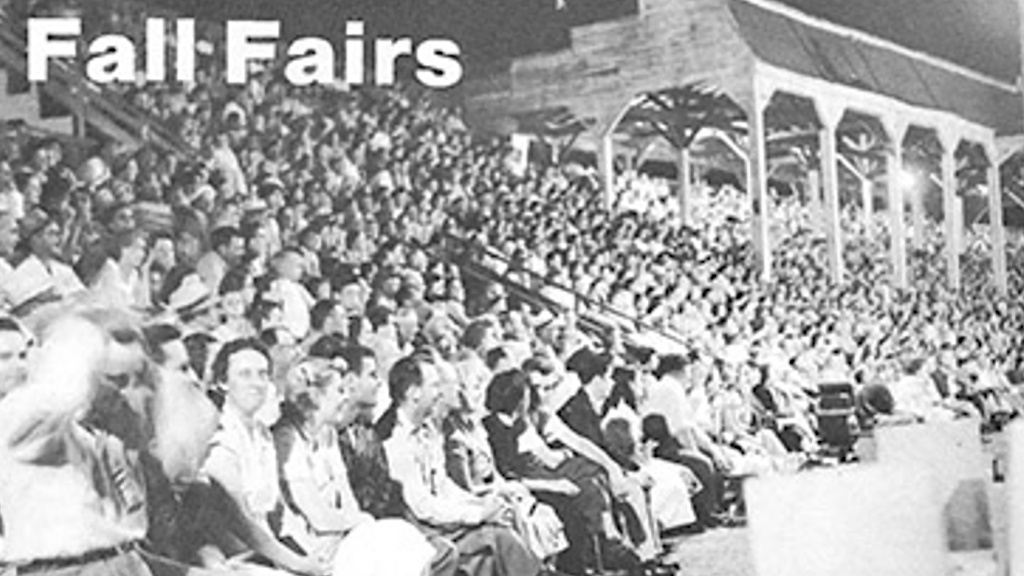
In this week's Rewind, Robert Smith has chosen an autumn-themed piece. He recalls the days when harness racing at small-town fall fairs made up much of the annual racing calendar across the land. He also sends out a Thanksgiving Day greeting to the reading audience.
In days gone by, long before the advent of large racetracks and extended harness racing, much of the year's racing took place at literally hundreds of places across the land. Once a year, the fairgrounds that existed in nearly every small town came alive for a day or perhaps up to three or four days, depending on the location. It was Fair Time!
With a hint of fall in the air and the month of October showing on the calendar, it's hard not to think a bit about fall fair time. I know this is not a new topic on 'Rewind', but it has always been a favourite of mine and one I enjoy revisiting from time to time. It is amazing, with all of the changes that we have seen, particularly in recent years, that fairs continue to be a popular pastime for young and old alike. Unfortunately, virtually all of them no longer feature harness racing as they once did, but we can still reminisce.
NORFOLK COUNTY FAIR
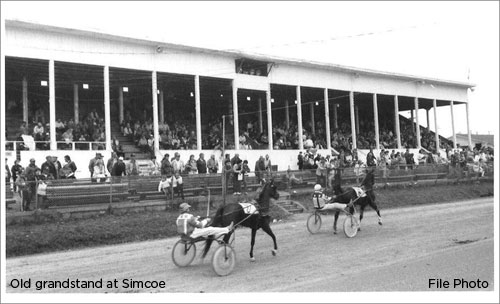
Fairs have been a form of celebration for Canadians dating back over 200 years, and the Norfolk County Fair, held each year on Thanksgiving weekend in Simcoe, is a classic example of an old-fashioned fall fair. The first fair in Ontario was held at Niagara-on-the-Lake in 1792 under the sponsorship of Governor Simcoe.
The Norfolk County Fair was first held in 1840 and was the ninth fair organized in Upper Canada. Today, it is the country's oldest and will celebrate its 186th birthday this year as it runs from October 6 to October 12. Its lengthy record makes the Fair 27 years older than Confederation and 11 years older than Canada's first postage stamp.
Many years ago, I had the pleasure of attending the Fair for several years in a row, and I can speak with firsthand knowledge of what a great show this was; there may have been none better. It was even more memorable as I attended with my two brothers (one had show horses), who probably attempted to distract me from my journalistic endeavours by encouraging me to partake of "adult beverages" while back at the barns. It was not an easy task.
Harness racing at the fairs was slightly different from the modern-day version and at times included some rather unusual and outright strange happenings. When someone said that they "had seen it all", usually a new twist made its way into the long line of stories.
One year at Simcoe, I recall a saddle horse getting loose from its rider while showing in the infield. Unfortunately, a race had just started, and the horse bolted out onto the track. The race was quickly halted, the drivers gathered hastily to discuss a remedial strategy, and within a brief few moments, the race was restarted.
On another occasion, the Bob Belore-operated starting gate refused to run. The races had to go on, so a nearby pickup truck was summoned and driven out on the track. Starter Belore stood in the back of the truck with his arms outstretched, giving drivers the necessary instructions, and soon the sound of "They're off and pacing..." was heard from race announcer Lee Paul.
After a history of racing that spans three centuries, in 2010 the organizers of the Norfolk County Fair announced that, for the first time perhaps in history, there would be no races.
The following excerpt was taken from an August 2008 copy of LEGION magazine. It reveals some interesting details of how and when country fairs first began. Today, some 260 years later, fairs are still popular but have obviously undergone many changes.
On May 21, 1765, approximately 100 farmers from the District of Windsor in central Nova Scotia, just west of Halifax, trudged along rough and rutted dirt roads to the settlement that had sprung up around the British garrison known as Fort Edward. They left behind fields and farms to participate in the first country fair to be held in North America, and they brought with them their best livestock -- horses, cattle, oxen, hogs and sheep -- not to mention samples of their grain and homemade foodstuffs.
Harness racing at fairs reached its peak during the 1940s and '50s. As an example, 72 years ago, in 1954, at least one day of racing was held at a total of 206 locations in nine provinces across the land. While not all were part of fairs, the majority were. Listed by province, the number of locations is shown in parentheses: Ontario (124), Quebec (24), Saskatchewan (21), Manitoba (13), New Brunswick (8), Nova Scotia (7), P.E.I. (5), Alberta (3), B.C. (1), Newfoundland (0). Those 70-plus years have spelled a lot of change.
In the small town where I grew up, our annual fair was an important part of most residents' annual entertainment calendar. People set aside the days to attend the events, and many were involved in various capacities on a volunteer basis.
I can recall the time when all of the 14 local schools, most of which were the one-room type, assembled on the opening day of the fair and marched several blocks, ending at the fairgrounds. Each school carried a banner showing their school's SS, as it was known in those days. Children wore simple crepe-paper sashes and armbands. A judging took place, with an award going to the best-looking school's marching corps.
Of course, once inside the fair's gates, it was a day of fun. I am pleased to say that the fair is still ongoing, now in its 172nd year, having started in 1854. In the early years, they had harness racing, I'm told, but not in my lifetime.
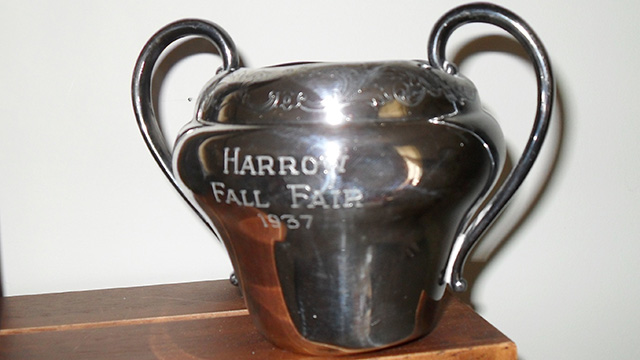
Above is an old silver cup awarded to the winner of a harness racing event at the Harrow Fair, dated 1937. This oldie was given to me many years ago by members of the Harold Wellwood family. It was won by one of their early horses. I can recall my father talking about how ahead of its time it was, as the track record was around the 2:00 mark. Thankfully, he did usually include the disclaimer that the track was somewhat short of a half-mile.
As recently as a couple of generations ago, virtually all horsemen served an "apprenticeship" on the fair circuit. That is where most new drivers, and for that matter, new horses, were tried. Once proven, the move to the "big tracks" took place. I would venture a guess that even a number of today's older drivers remember the days of the fairs, and probably with fondness. Many of those drivers continued their allegiance in the years that followed, as evidenced by this excerpt, which appeared in The London Free Press in a 1961 column by noted racing scribe Harry Eisen.
Keith Waples, 37, of Victoria Harbour, Ont., will fly home from Montreal to drive in the 10-dash harness race meeting over his home Coldwater, Ont., track Saturday. Assisted by his younger brother Murray, 32, also a capable driver, the Waples brothers have nine horses racing at London, 30 in Montreal and another seven at Saratoga Springs, New York... This says more than a little about a top driver's feelings toward the importance of fall fair racing.
While today the era of fall fair racing is but a distant memory to many, there are still those around who got their start there. The racing was often a bit disorganized; sometimes races were held up for what seemed like forever, waiting for an entrant to make their way onto the track.
Many other similar calamities were natural occurrences of those long-ago days. Whatever it was, people loved it and showed up in droves to watch their favourite steed in action, and when the season was over, they couldn't wait until the next year.
Although many fall fairs remain, their heyday is a distant memory. I can recall a gentleman many years ago telling me about the demise of his hometown's fair. He said, "It just kept getting smaller and smaller until finally only a cow and a pumpkin remained. The cow ate the pumpkin and the cow died..."
Old-Day Scenes at the Fair
The following old photos were all taken during fall fairs, and each one relates to some aspect of these great institutions.
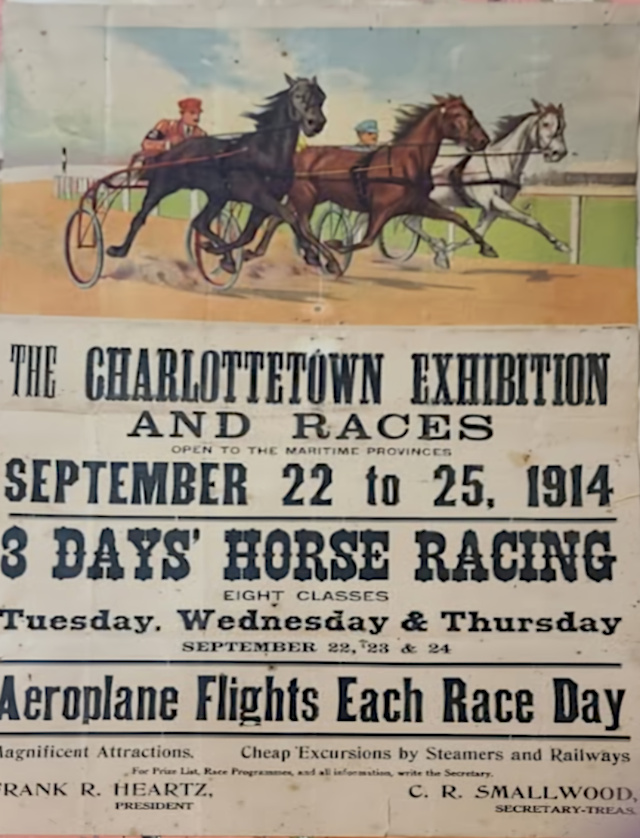
An ad from Charlottetown Exhibition in 1914.
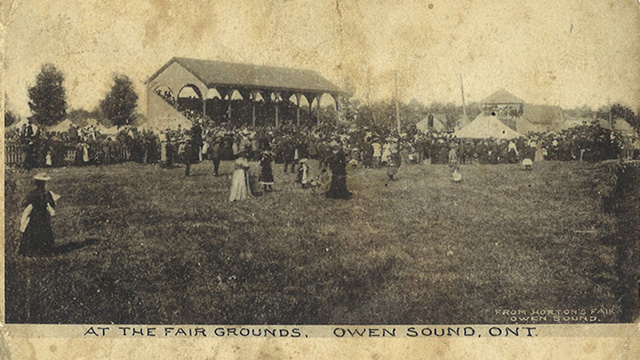
An old-time fair scene taken at Victoria Park in Owen Sound, Ont. (Reprinted with permission from The Grey Roots Archival Collection.)
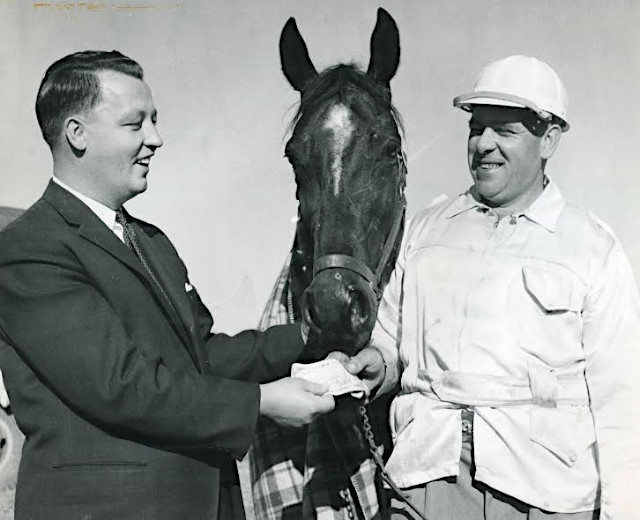
Local politicians often showed up at the fairs on race days. In this circa-1960 photo, Keith Brown, MPP for Peterborough, is shown presenting a $25.00 cheque to driver Frank Alexander. The location was the Norwood, Ont., fair, and the winning horse was Johnny Dale, owned by John R. Ball of Baltimore, Ont.
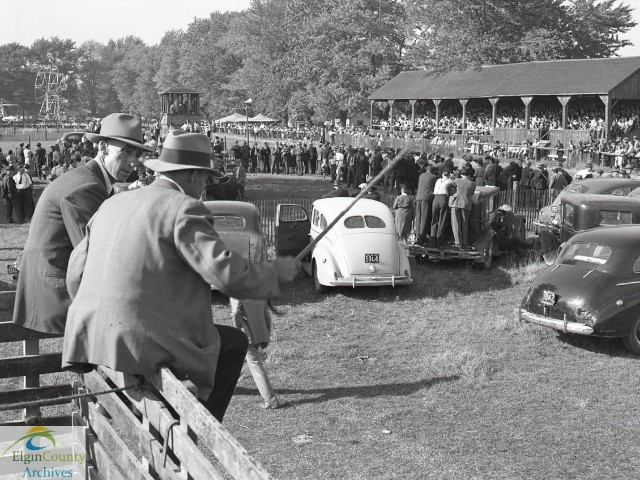
An old scene from fair day at Wallacetown, Ont.
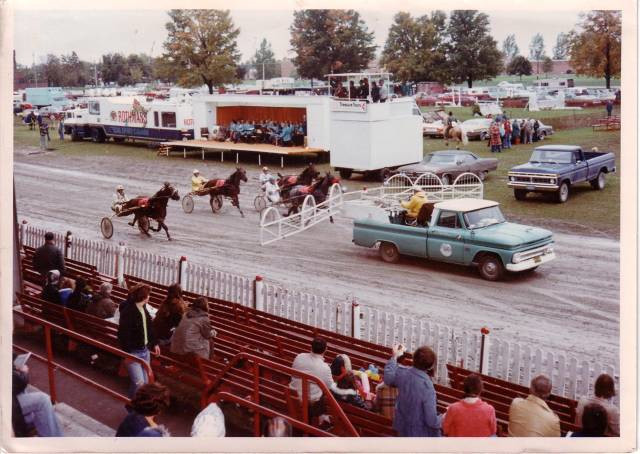
A view from the Lindsay Fair showing starter Archie Cochrane sending a field on its way. The judge's stand is in the infield.
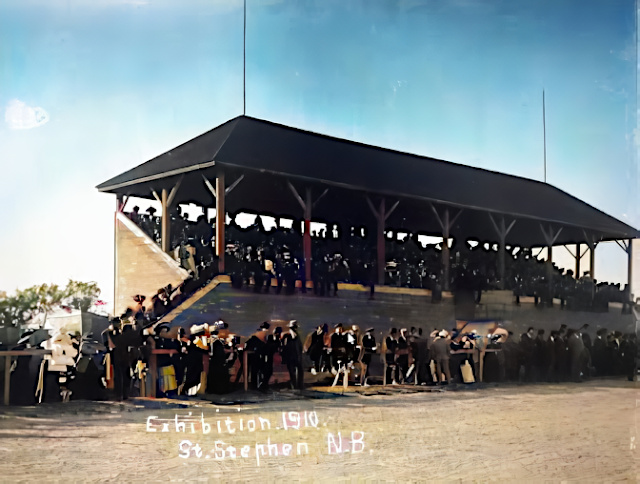
The grandstand at the St. Stephen, N.B., horse race track in 1910, at the Exhibition Grounds. They were a premier event in the community, particularly the races held during the County Exhibition, where race entrants would come from all over the Maritimes and Maine.
HAPPY THANKSGIVING DAY
I would like to send out a special Thanksgiving Day greeting to everyone in the Rewind audience. Monday, Oct. 12 is a very special day as we gather together to give thanks for our many blessings, now and throughout the year. The tradition of this day has deep roots in gathering with family and friends in a spirit of goodwill and friendship. Many traditional foods are served and enjoyed.
I am personally blessed to have a loving wife and family that enjoys celebrating this day and time of year. Thankfully, my seniority gets me a pretty good seat at the table.
Quote for the Week: "Fall fairs awaken the child in us all."
Who Are They?
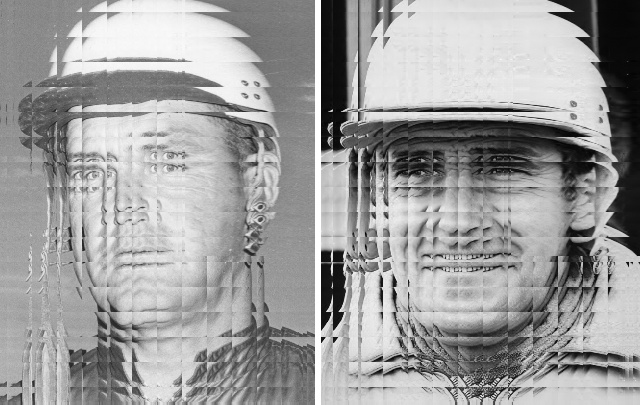
Can you identify: (at left) a fellow who truly loved to race at the fairs, even though he was one of the sport's top horsemen, and (at right) a well-known driver who spent a lot of time on the Ontario fair circuit along with a very busy schedule at the "A" tracks?
(The correct answers will be posted here by Robert as a comment in a few days.)
Blast From the Past
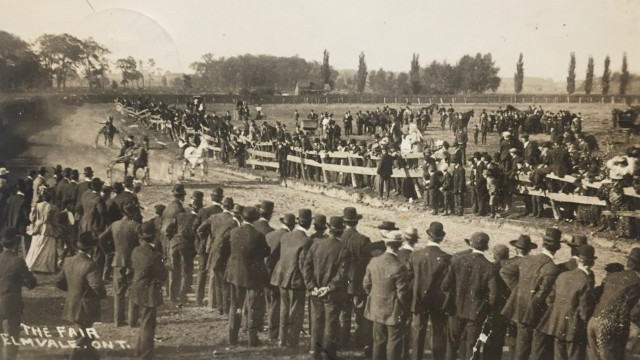
This very antiquated photo depicts every aspect of the "old days" of harness racing. The fields were sometimes small, the tracks were often very narrow, and the surroundings were about as humble as could be.
Fair Racing
I remember it has to be almost 60 years ago I looked after 3 horses at the Oshawa Fair. I raced Mr. Forbes Key, Jerry Hat and Peggy Will. I had to race them because the owners ( one was my uncle and his cousin )decided to go drinking instead of racing. I was around 10 years old and I won all three races with Gerald Robinson driving. Like everyone I miss Orono Fair, Port Perry Fair, Lindsay Fair, Norwood Fair Oshawa Fair and the Markham Fair. Thanks Robert for bringing back old memories. Happy Thanksgiving.