


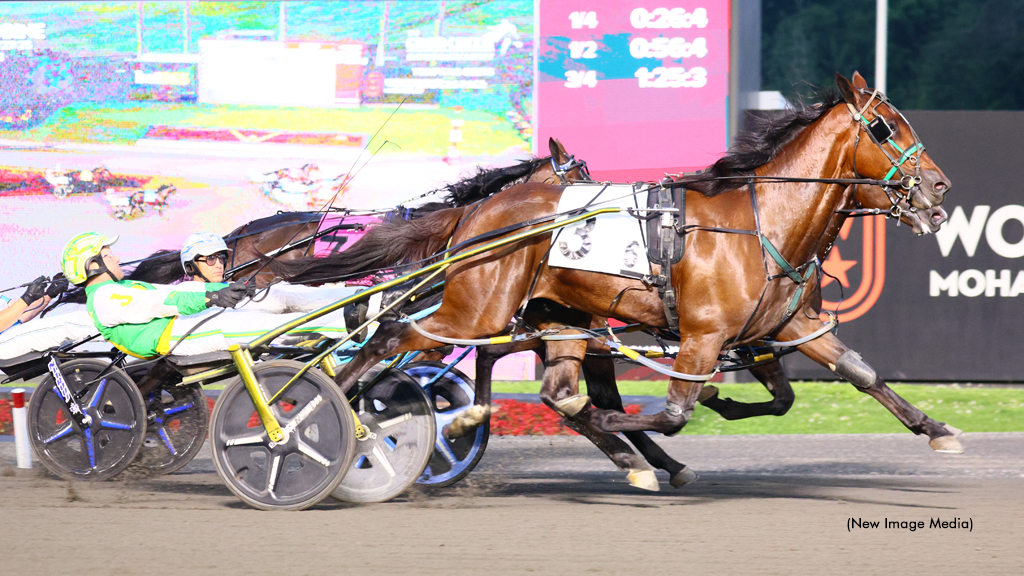
With the freshman biggest stars of 2025 ramping up their three-year-old campaigns, Trot Insider continues to profile the top contenders for the 2026 Pepsi North America Cup.
A two-time stakes winner at two, Tilthecowscomehome is ranked 10th at 26-1 in TROT Magazine’s 2026 Pepsi North America Cup Spring Book.
The son of Cattlewash-Dance Until Dawn, a $94,595 Lexington sale buy, won his debut in eye-catching fashion. He was fifth on the inside entering the far turn but weaved through traffic down the lane and sprinted late for Jody Jamieson to win his division of the Tompkins-Geers in 1:52.4. The colt dropped two seconds in his next appearance in a 1:50.4 mile in the first Ontario Sires Stakes Gold leg — but with eventual Horse of the Year Beau Jangles pacing in 1:50.1 in his debut, it was only good enough for second. Beau Jangles bested him twice more — in another Gold event and the Battle of Waterloo — before Tilthecowscomehome rallied between horses in late-stretch in the Grade 3 Nassagaweya Stakes to post a 1:50.3 win.
He went on to finish second to Beau Jangles in Gold leg four, second behind Windor in the Grade 3 Champlain Stakes, and third in his Metro Pace elimination before a fifth-place finish in the final. His run of cheque-earning starts continued as the Carl Jamieson trainee was then third in the final Gold preliminary and the Super Final, but he ended the season as he came home seventh in his Breeders Crown elimination.
Tilthecowscomehome, owned by Carl Jamieson of Puslinch, Ont. and Jody Jamieson of Guelph, Ont. along with Joanne Morrison of Beeton, Ont. and Blair Corbeil of Leduc, Alta., earned $378,102 with a 2-5-3 record in 12 starts. He's made three starts this season, most recently finishing a solid third to the undefeated Beau Jangles in the first OSS Gold leg of the year on May 23 at Mohawk. He's back in this weekend, saddled with post 10 in the $140,500 Somebeachsomewhere (Grade 3).
Trot Insider caught up with Carl Jamieson as Tilthecowscomehome in advance of his sophomore season.
Where did he winter and when did you start back with him?
“He was turned out up in Fergus. He was up there for the winter. Then we just brought him back down to the farm and trained him back until he got to First Line. [We started back with him] at the end of January.”
Have you noticed any changes from last year to this year?
“He grew a little bigger than he was. He was a big colt anyway, but he grew quite a bit. He looks good and he's feeling great.”
“He’s a little studdier, I think, than he was last year. Last year, he wasn’t studdy at all, this year, he knows he’s a stud.”
What does his tentative schedule look like after the North America Cup?
“Anything in Canada, the bigger stuff in Canada, plus there’s other things. We didn’t cross the border with him. There’s so many races at home, no sense in trucking to the States and going against the American-bred horses when you’ve got good money at home.”
What's his biggest asset / strength?
“His gait, his breeding and his good attitude.”
At what point last year did you think this horse was North America Cup material?
"He was just a good horse. Every time I raced him, he got better and better and better. So I was looking forward to beating the other horse [Beau Jangles], but couldn't beat him."
As someone who has won this race before, how does it feel to have another horse that appears to have a legit shot at the North America Cup?
“It’s pretty nice to have a horse in [contention for] a race going for a million dollars, and be in the top 10. I think it’s great.”
(Standardbred Canada)