Their farm doesn’t have a track, so they jog their horses down country roads and through the bush. Their original choice of sire was back racing when they were ready to breed, so they bred to another one, far from home, at the last minute, on a whim. The resulting filly was so anxious she travels everywhere with her own Shetland pony. The trainer is a high school teacher and the co-owner - his 11-year-old daughter, who has full-say in daily operations - is the calm and collected one. It’s also a father-daughter team who has experienced great loss, and have bonded and healed through their love of horses. This might sound like a Disney movie - and it probably should be - but this is the true story of Neil & Rory MacInnis, Rhodena Blue and Queenie, and this past year the fearless Canadian foursome left their mark on racing in the state of Ohio. By Keith McCalmont.
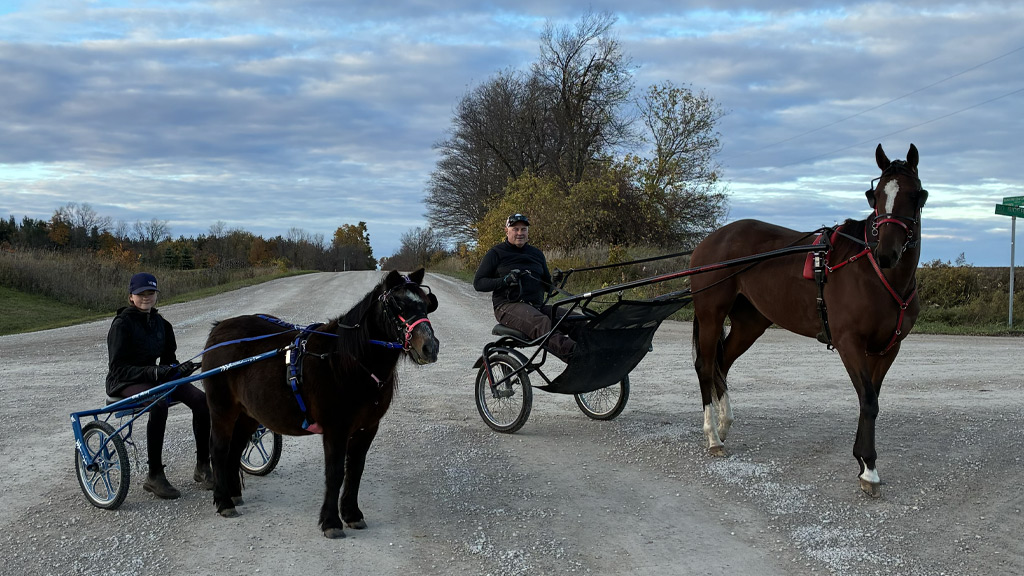
Queenie, a Shetland pony and companion to the three-year-old pacing filly Rhodena Blue, will find it fitting that her name comes first in a story that celebrates the resilience of a father-daughter training team.
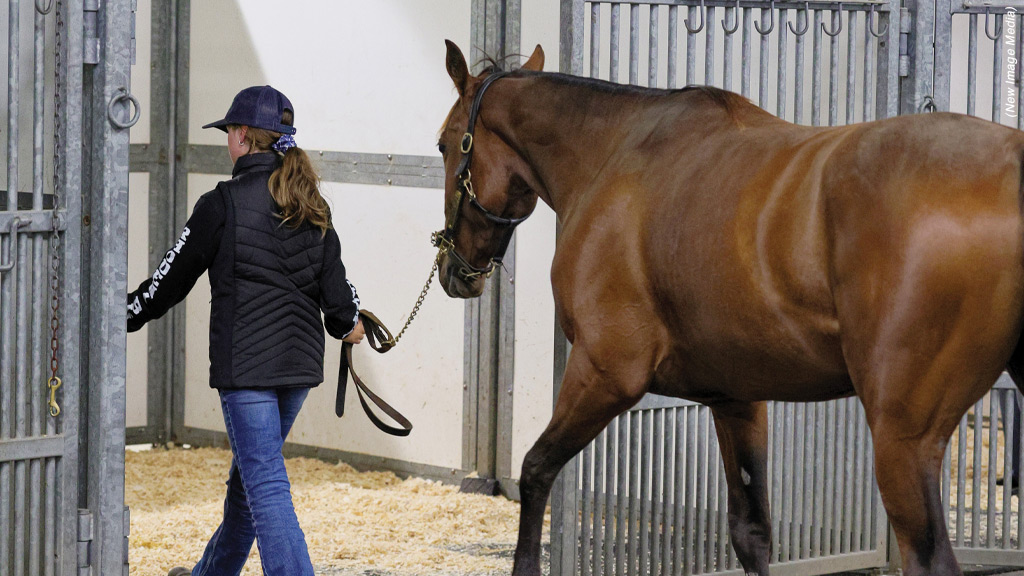
Owned and driven, yes driven, by Rory MacInnis, the 11-year-old daughter of trainer Neil MacInnis, the cheeky Queenie is a fixture in conditioning sessions at the family farm in Primrose, Ontario. She was also the shipping partner for the formerly nervy Rhodena Blue, aka ‘Hazel’, on their hours-long treks stateside to participate in the Ohio Sires Stakes (OHSS) program over the past two years.
“They’re friends but they cannot admit it,” said Rory, who implored her father to use Queenie as a travel companion for their homebred filly. “Without Queenie, Hazel would be freaked out. Hazel can’t really admit that she needs her, and when Hazel is off property, Queenie is not happy at all.
“Queenie doesn’t mind the trips to Ohio,” she added. “She likes meeting new horses and the new surroundings.”
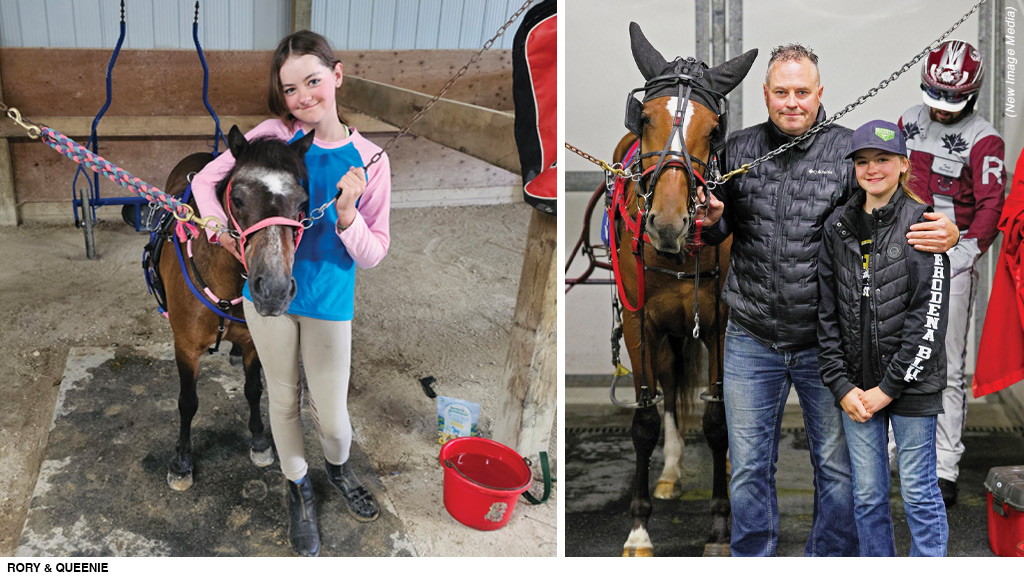
Rhodena Blue, by Lather Up, and out of the Camluck mare, Mc Taylor, made $18,937 in seven starts as a two-year-old, her lone win coming while pacing greenly during a rough first-over voyage in a Buckeye Stallion Series event at Northfield Park. It was a tough trip for a second lifetime start, and it was followed by a series of troubled outings.
“She wasn’t ready for that kind of trip,” Neil MacInnis said. “She won the race, which was wonderful, but for a while after that she was hard to manage on the gate and made a lot of breaks. She was also going through a growth spurt.
“I remember Brett Miller driving her at Urbana… she caught up to the field [after a break] and got caught behind some tired horses and finished fourth,” MacInnis continued. “He told me we had a nice filly, so I knew we had something, and that if I gave her the time that she might amount to something.”
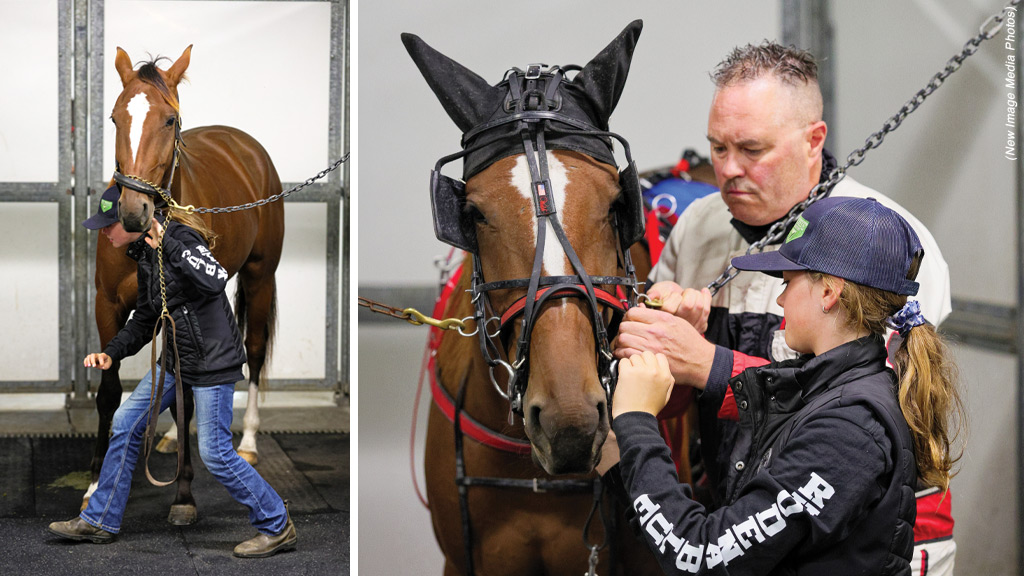
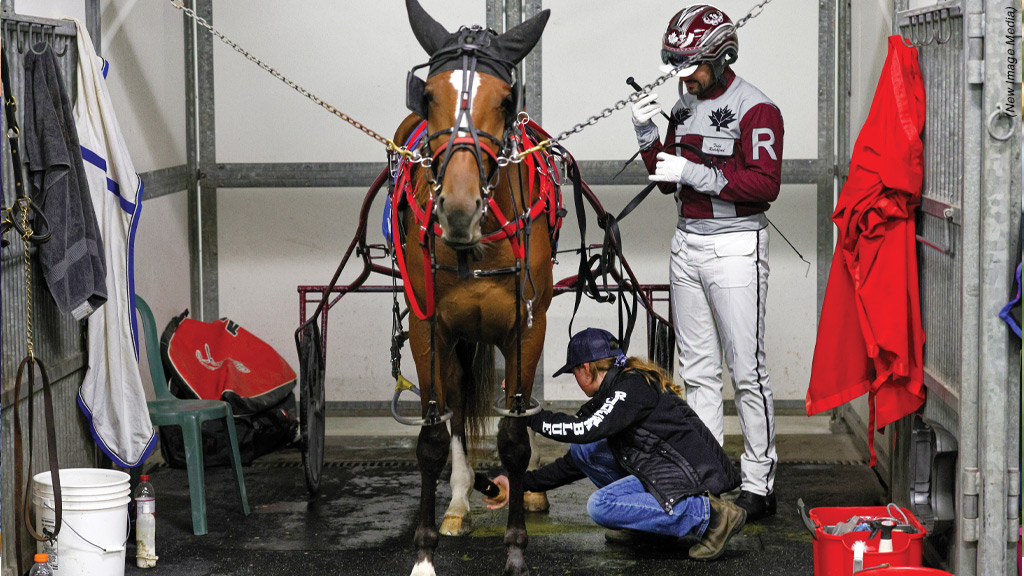
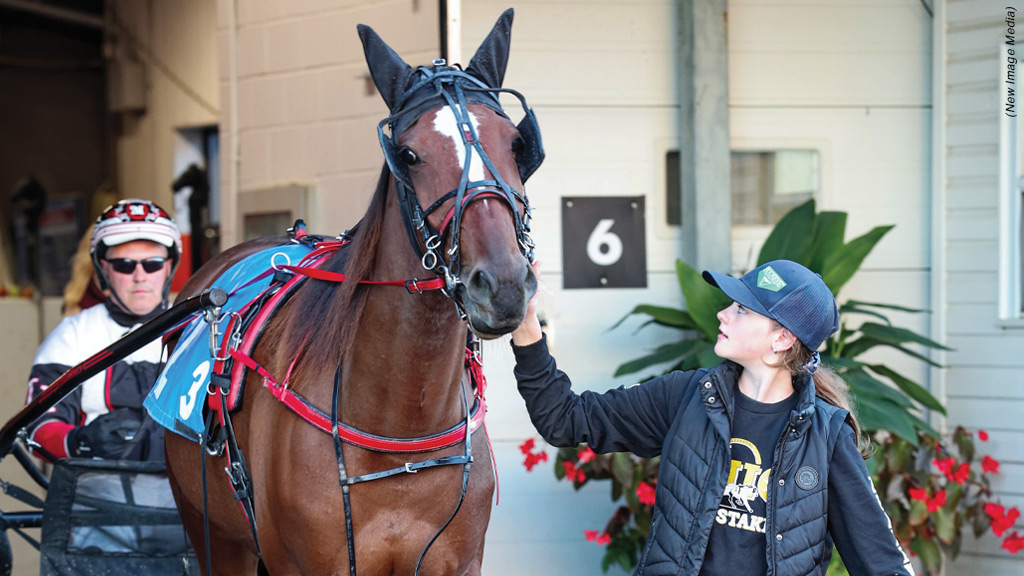
Fast forward one year to September 12, 2026 and Rhodena Blue is in the Scioto Downs paddock awaiting her start in the $300,000 (USD) OHSS Scarlet Championship final. MacInnis takes care of the warm-up laps and Rory, an experienced horsewoman at this stage, is more than comfortable to paddock the filly on her own.
“So, Rory always gets her ready after we arrive at the track, and I don’t come back until I have to warm her up. After that I leave again,” starts MacInnis. “I came back, before the final, about five minutes before post-parade, and Hazel was sound asleep in the paddock stall. Out cold.”
Rhodena Blue, who could come undone as a two-year-old, was preparing for the biggest race of her life thus far, with a pre-game nap in the cross-ties? Her trainer, an admittedly nervous type himself, was beside himself with worry - is she sick? Is it colic? Did she tie-up?
“We were putting the bridle on and I was checking the harness over,” Rory recalls. “I can remember his exact words, ‘Rory, I think there’s something wrong with her!’ And I said, ‘No dad, she’s asleep. She’s just having a rest. That’s what she does. Don’t worry, she’ll wake up when she’s on the track.’
“The year before we made a lot of trips to Ohio and she wasn’t mature enough,” Rory continued. “She was all over the place. Now, it’s the opposite and she’s getting really good with her paddock personality. She just needed experience, and I think now she has the experience - even Queenie is used to it. They have the routine and the trip covered.”
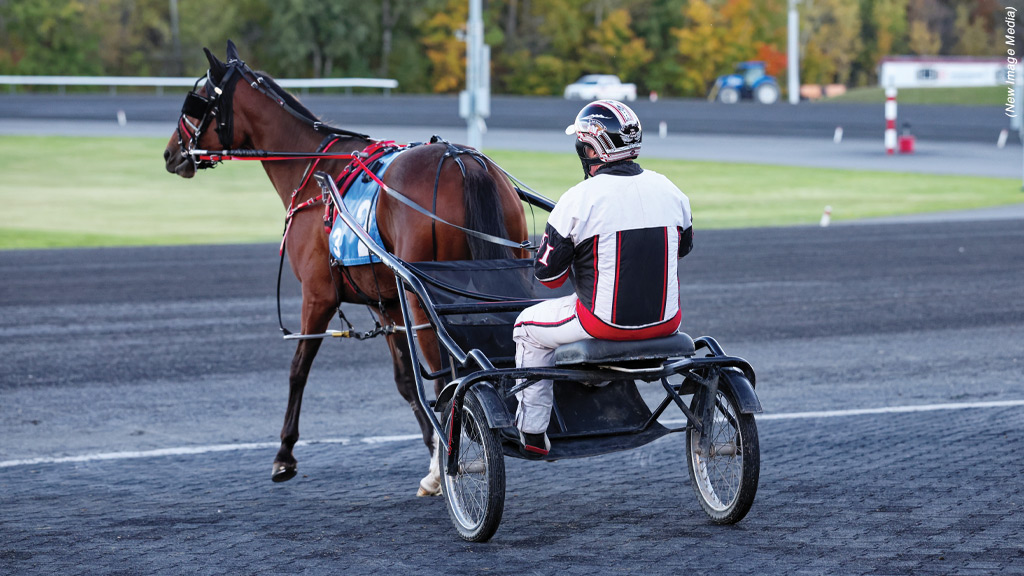
Rhodena Blue woke up in a big way in the final, closing from seventh in the early-going to finish third, beaten only a length, to the victorious Seaside Shuffle, pacing her own mile in 1:51 and securing a $50,000 (CDN) cheque in the process - the biggest of her career thus far.
As for Queenie, the ever-present pony, she has become a local legend in Ohio, even having spent one evening inking “hoof-o-graphs” on a children’s book made by the Ohio Harness Horse Association in honour of the unlikely raiders from the north: Queenie, Hazel, Rory and Neil.
“They wrote a picture book about our travels and made Queenie available for a hoof-and-sign in the paddock one night. They even put us up in the casino hotel that night to help make it happen,” MacInnis said with a laugh. “She’s a rockstar down there.”
* * * * *
In 2020, as the COVID-19 pandemic wreaked havoc on the world, the MacInnis family saw their own lives torn asunder in another way as well. In December 2019, Neil’s wife and Rory’s mother, Sarah, was diagnosed with ovarian cancer. She passed just a few months later, in March 2020.
“We didn’t see it coming. There was no indication. It was over as quickly as it began,” MacInnis said. “We were isolated because of COVID and none of my family could come. It was difficult to deal with on your own.”
Neil lost his interest in the horse world, but when he was packing up his equine gear in the barn a few days later, in an effort to turn his back on a part of life that they had enjoyed so much together, he came upon a note left to him by his late wife, an avid equestrian, which he found in a feed tub where she had left it for him.
“It said, ‘Please, with Rory, do the little things and follow your passions.’ No other phrase in life has affected me more,” MacInnis said. “The little things become the big things, and I’ve lived that.”
The note resonated, and Neil and Rory began spending their mornings and evenings together in that same barn, taking care of and training their horses.
“My daughter and I have so many bonding moments between 5am and 7am, before I leave for work. That’s when we talk about a lot of important things on a daily basis,” MacInnis said. “Rory had to grow up really fast and I put a lot of expectations on her out of necessity. If I’m trying to make dinner and she could just run out and feed the horses or bring them in… it was a big help.
“My friends have noticed and marvel at the expectations I put on her,” he continued. “If there’s a shoe loose and it needs a nail fixed, she’ll run out and do it for me. How many 10 or 11-year-old girls are doing that?
That first summer, Neil and Rory headed home to the East Coast with a horse named Yankee Osborne, in an attempt to return to some sense of normalcy.
“Rory and I packed up the dog, the cat, Yankee Osborne and our two-year-old homebred [bred by Sarah] named Rhodena Road. It was tough, but we had some success,” MacInnis said. “Osborne set a track record at Truro Raceway [1:52]. In his Gold Cup & Saucer Trial he made a break, but he still finished second in the consolation. Racing gives both highs and lows, but that was when Rory and I began working in tandem.”
MacInnis, who works full-time as a high school English teacher in Brampton, and now faced the task of raising his grieving young daughter alone, struggled with depression and anxiety following his return to Ontario. At the same time his number of starters as a trainer dwindled.
“I was driving through Mississauga one day in February, a year after Sarah had died, and I was having a really hard time. I pulled into a spot on Dundas. I was thinking, I can’t do this anymore. It’s time to pack up and leave.
“I was in front of a diving shop and I just walked in and said, ‘I need something to occupy my mind and time,’” Neil recalled. “The guy at the shop said, ‘I’ll teach you to become a search-and-rescue scuba diver - you start Saturday.’
“It saved me from the brink of despair. I was down there on Saturday freezing my ass off. Then the horses got going and I got back to training… and my daughter continued to take an interest.”
MacInnis is stoic as he shares the depths of his grief and the pain of being unable to shield his wife from the damned cancer.
“I decided in the last year to talk about it more openly, in the hope that anybody else going through something will know that hope is a good thing to have, and if you keep moving, you will come through it,” MacInnis said. “You have to move toward something, and you have to embrace it. There will be a lot of days you don’t want to get out of bed, but you have to.”
* * * * *
MacInnis embraces his Celtic heritage having grown up in the rural community of Creignish, located in Inverness County on Cape Breton Island, Nova Scotia.
“My father, Frank, was a school administrator and my mother a nurse. They both came from hard-working families. Salt-of-the-earth people,” MacInnis said. “Dad was a great athlete and loved Celtic culture, and he took my brothers Ross, Allan, Donnie and I everywhere he went. My memories are distinct in that we were constantly surrounded by farmers, woodsman, fisherman, and hard rock miners. Many were war veterans who fought in some of the world’s greatest conflicts. We revered the Cape Breton Highlanders.
“All of them, to some degree, had horses. We were steeped in Celtic folklore and tradition,” MacInnis continued. “My father loved horses, and I suppose he fell into training and racing naturally. He was about 14-years-old - he didn’t even have his license - when he started driving the local old-timers to the races on a Sunday in Inverness. In the winter, he often attended the racing on the ice. His passion just grew from there.”
MacInnis said the core memories of his youth revolved around attending the races with his family in Inverness.
“As much as my father loved going to race, he loved just as much meeting up with friends. He knew many names recognizable today, the Walkers and the Copleys, the MacDonnells, Gillis’, MacEacherns and MacDonalds. You ask any horse person about the desire to be around horses, and they will tell you that it’s biological, it gets in your blood, and you can’t imagine being without them. It’s just a way of life.”
Speaking of family, it was actually through Neil’s brother, Ross, that Rhodena Blue came to be. The intended sire was Bulldog Hanover, but when Mc Taylor was found to be in-foal to Bulldog with twins, an attempt to pinch one ultimately resulted in the loss of both. With a then four-year-old Bulldog back to racing at The Meadowlands by the time she was ready to be re-bred, it seemed all was lost. Unbeknownst to Neil, however, his brother had secured Ohio sire Lather Up as a back-up plan, and when Sugar Valley Farms called one day to see if the plan was “still” to breed her to their stallion, Neil agreed - even though it had never really even been the plan.
Sometimes, fate will take the reins.
And so, Rhodena Blue, an Ontario homebred owned by MacInnis and his daughter, came into their lives, and was given a name that honored their shared heritage.
MacInnis names his horses as an homage to the former community of Rhodena, just above Creignish, that was once home to his grandmother, Cassie MacMaster. Rhodena Blue, named after the town’s blue spruce mountain backdrop, trains in a manner fitting to the old-school roots in which MacInnis was raised.
MacInnis and Rory will train or jog their steeds, either morning or night, according to their busy schedules, which includes the former’s teaching responsibilities and the latter’s school days and commitment to her sport pony, Bow, with whom she competes with regularly.
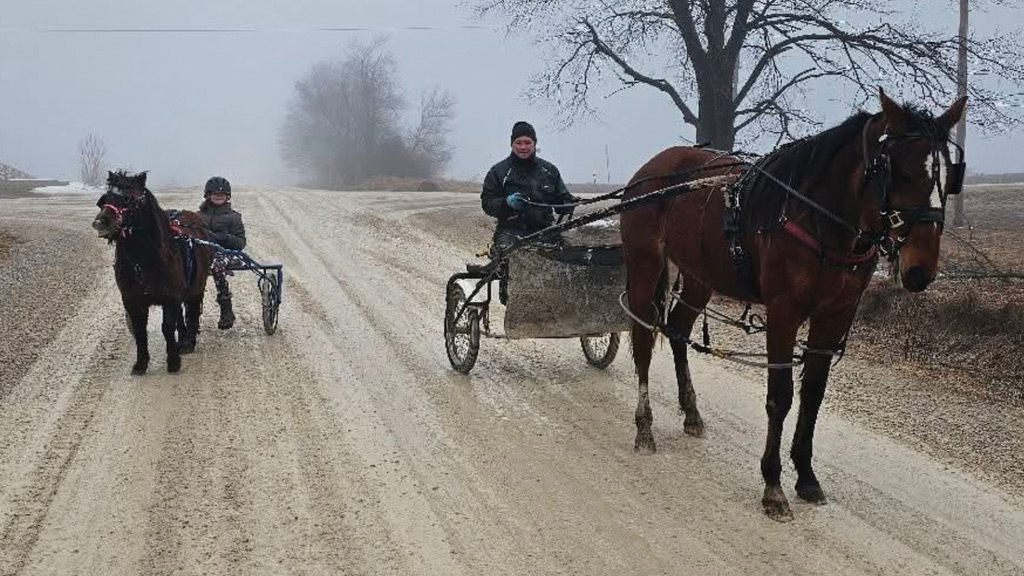
While their 15-acre farm is spacious, the conditioning sessions occur not on your typical oval, because there isn’t one. Instead, it’s a tour-de-community, with MacInnis piloting Hazel and Queenie in-rein to Rory.
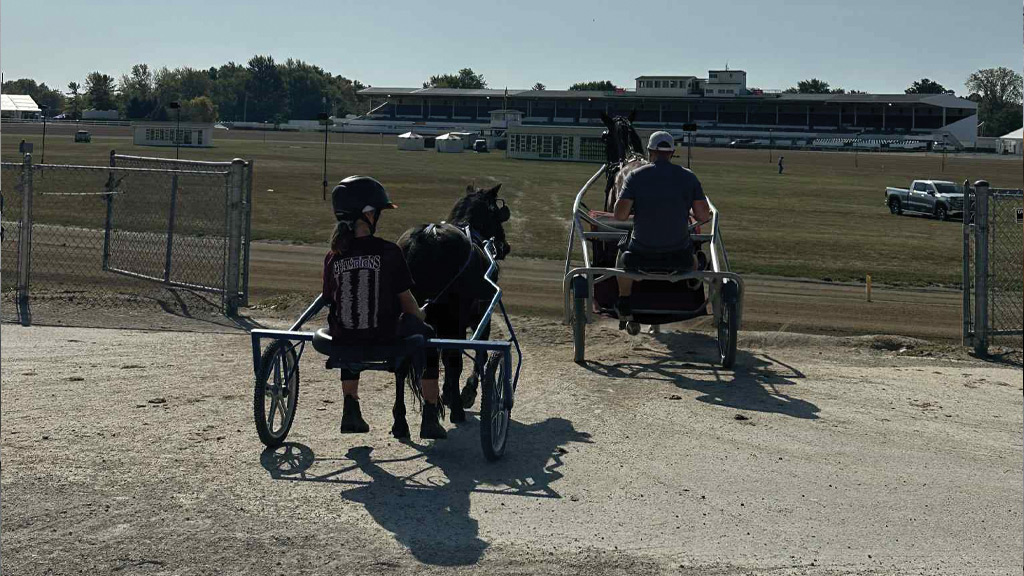
“Hazel and Queenie head out together and we head off into the hills. We go when we can. Some mornings we’ve gone out with miner-lights on,” Neil said with a laugh, “and when we go in the evenings we often see a number of deer along the way. Rory will come with me the first three or four miles and then go in. Or I can turn back with her and head out again. It [my regular course with Hazel] can run anywhere from six to eight miles. It’s a great way to keep a horse fit and they never get bored. We’re often out on the road for an hour-and-a-half.
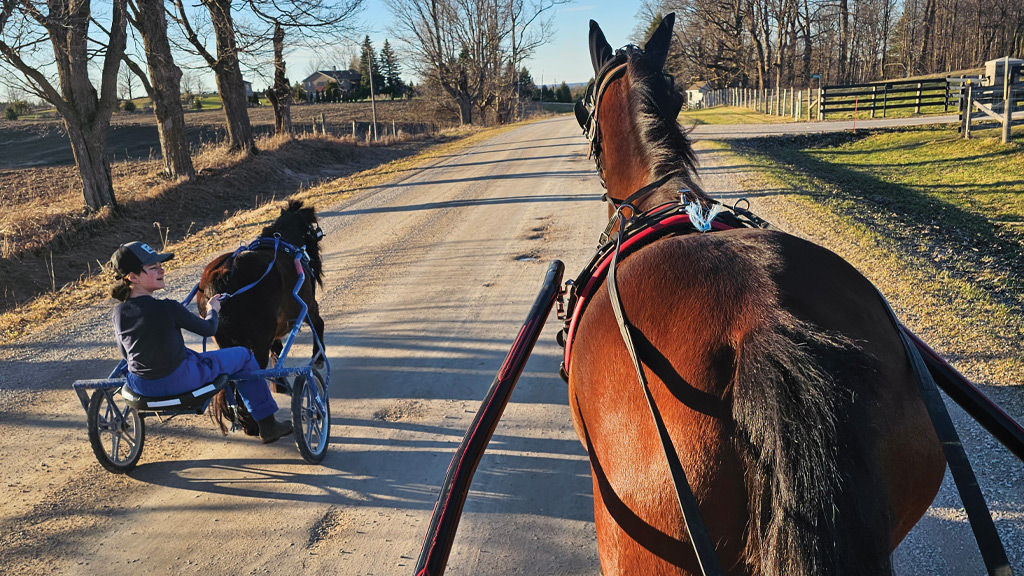
“When she’s in to race I have a routine where I’ll take her out and for the first half-an-hour she goes at a pretty relaxed pace,” MacInnis continued. “I step it up in the second half-hour where she’ll jog faster... There’s a stream where she likes to slow down and stop and stand in it and drink, and then we come through the stream and she has to pick it up again. I know they’re really fit when we get up to 11 miles... If she’s not sweating much on the way back, I know she’s ready to go. They love it and every day is different. Our horses are also turned out most of the time 24-7. We have a five-stall barn, but they rarely spend any time in the barn.”
Whatever their routine is, it seems to be working. As of press time, Hazel - aka Rhodena Blue - has churned out a three-year-old stat line of 10-3-2-1, with a speed badge of 1:51.4, good for sophomore earnings of $125,872.
* * * * *
There’s an Irish saying that goes, ‘Níl cara ag cumha ach cuimhne,’ which translates to: ‘Memory is grief’s only friend.’ It’s an acknowledgement that time does not eliminate grief, but that the memory of that loved one becomes your companion.
MacInnis, with the encouragement of his friends and family, has bravely moved on and found love again with his new partner, Jacalyn, and her daughter Phoebe, who happens to be the same age as Rory.
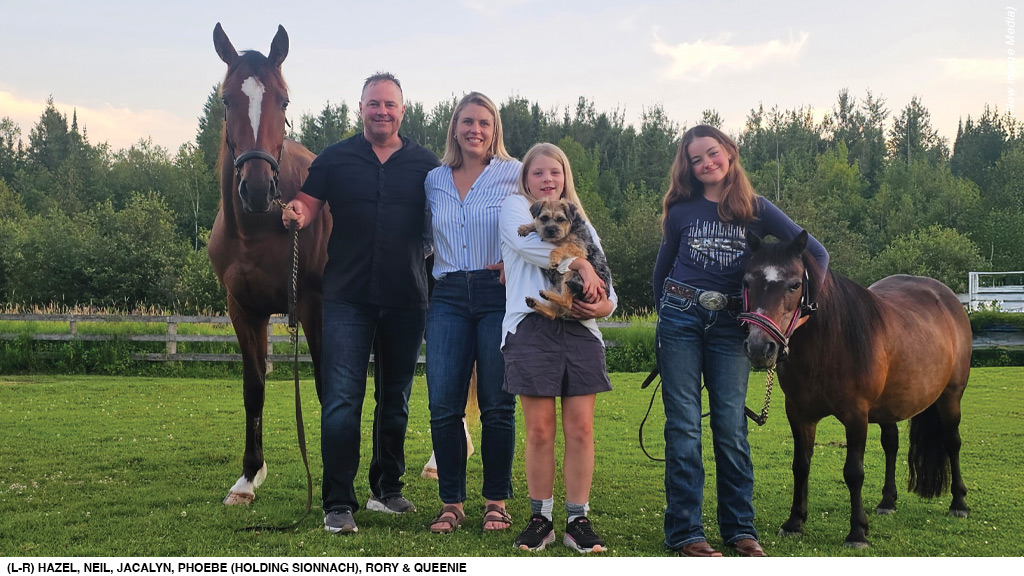
“They became an anchor for me and for Rory. I’m really lucky for that,” Neil said.
MacInnis, keen to maintain his Celtic roots, is wont to use the old language around the farm and often refers to the foxes they sometimes see on their travels as the ‘sionnach.’
“Foxes have deep cultural ties to our Celtic heritage. They are seen as intuitive and resourceful - a spiritual guide who navigates unseen paths,” MacInnis explained. “After Sarah had passed, a copper-colored fox with distinct white markings would visit. It often comes into the paddocks, circles around the broodmare, comes within 10 feet of us and then scurries off. It is magnificent to watch. I have often seen her when we head up into the hills jogging the horses, peaking through a gap in the brush.
“One night, Jacalyn was sitting on the deck looking over the paddock and the sionnach came up close to her and stood for a bit before heading off again,” an emotional MacInnis continued. “It was almost as if it was a sign, saying ‘Thank you.’”
Neil shared that Rory will sometimes head off into the hills alone with Queenie, and that he will keep his distance to allow her the space to process her own grief.
“Rory says she doesn’t see her out there, but the sionnach does appear often in the art Rory creates,” MacInnis said. “I think she sees more out there than she lets on. It’s not my place to ask, so I never say anything, as I think that something now exists that I don’t need to know or understand. I think this helps her connect to a somewhat unknown past and accept the loss.”
* * * * *
MacInnis acknowledged the support of the racing community as he comes through the other side of a difficult period in his life, while also looking ahead to a four-year-old campaign with Rhodena Blue. He noted his appreciation for both the life and equine advice of the retired veterinarian Dr. Hue Llewelyn, horseman Roger Mayotte, and practicing veterinarian Dr. Liz Shiland, to name just a few.
“Any success we have had, especially this year, would never have happened without their support and counsel. I’d call Roger on my way home to talk about planning for big races, and he was a great counsel for me. I’d call Dr. Llewelyn, wanting to talk about races, and he’d want to talk salmon fishing,” MacInnis said with a laugh.
MacInnis could only offer his sincere apologies to Dr. Shiland for his need for her endless review of emergency checklists at all hours of the night.
“Sorry, Doc,” MacInnis said with a laugh. “When I reflect now on the summer we just had, and what the last six years have been, I’m so damn lucky to have my racing friends.”
It was Dr. Llewellyn who first connected MacInnis with Dr. Shiland, suggesting she might be able to assist with Rory’s sport pony, Bow, who needed treatment for a respiratory issue.
“Somehow, the MacInnis family had me working on ponies again. I had to go dig out my little mini speculum and get the cobwebs off of it because I’ve done nothing but racehorses for almost seven years now,” Dr. Shiland said, with a laugh.
Dr. Shiland said the shared moments with the MacInnis family only brightened her summer, and that her family, including her husband, Eric, and their young children Adrien and Ruby, look forward to visits from Rhodena Blue and Queenie.
“Neil was trying to do his day job and train and race, so we worked it out that he would come up to my farm at the end of his day or the end of my day,” Dr. Shiland said. “It was really just a lot of fun because every time he came down with Rhodena, for me to go over her, check her blood, or whatever we needed to do, Queenie would always be with them.
“Sometimes, their two dogs were in the truck, sometimes their neighbor’s daughter would come or his partner, Jacalyn, and her daughter,” she continued. “Sometimes, it was all of them. It was just fun. My kids are ages five and nine and they would come running out to ride the pony in the arena while we were looking at Rhodena. We’d order pizza. It was just a good time.”
Dr. Shiland noted her deep appreciation for the way MacInnis trains and dotes on his stable star.
“It’s not about being hard on the horse and making sure they’re tight and training no matter what, it’s about what the horse needs. I think it’s fantastic,” Dr. Shiland said. “It’s all about the horse and what’s best for the horse.
“Once, Neil texted me after a race and said he might want to pull some blood on her,” Dr. Shiland continued. “I said, ’Ya, sure.’ And then the next morning he sent me a video - literally out of his kitchen window - of her running and kicking her heels up in the pasture. He said, ‘I don’t think we need to pull that blood.’ I said, ‘Nope, you just saved yourself a buck fourty-five!’”
Dr. Shiland also said she has observed a great bond develop between Neil and Rory through their love of the horse.
“I think horses give you a way to be together where you don’t have to speak,” Dr. Shiland said. “Sometimes, that can be really important as a parent and a child - and especially for a parent and a child that have had to go through what they’ve gone through.
“I think a big part of having Rhodena, and racing her together, is also them spending time together. They jog their horses together, they travel together, and it’s just an incredible part of their journey, too, after losing Sarah,” Dr. Shiland continued. “Rory is extremely capable, and I see Neil really allow her the space to do all of these things. Whether that’s loading the horse, hooking the horse, riding the horse. He’s given her the space to grow and develop into a talented young horsewoman.”
That MacInnis has surrounded his daughter with so many positive role models is commendable. Just through their every day interactions in the racing community, he’s showing Rory that there are many paths to success and happiness. That Rory is mature beyond her years is not lost on Dr. Shiland.
“Right away, I called her a horsewoman… but she’s a little girl. She’s a kid, but she presents so maturely and she’s so professional,” Dr. Shiland said. “When I’m done running my hands over Rhodena, she would like me to run my hands over Queenie. She wants to make sure she’s healthy and to discuss the eye that’s been a little runny or to check the teeth again. She’s very competent with the horses and you really do forget that she’s so young.
“I think the world of them both,” Dr. Shiland continued. “It’s been an absolute pleasure and an honour to be a part of their team this summer, taking care of Rhodena, fitting it in, making it work and watching her be so successful. It’s been fun for me as a veterinarian, and you don’t always hear a vet say it’s been fun, but it really has been fun.”
* * * * *
Neil MacInnis is philosophical in his approach to everything in life. He is proud of his daughter for how she has thrived, and one would hope he knows that those around him feel he should be equally content with his own growth.
“The past and the present are inescapable. We are the product of something catastrophic, but we passed through it,” MacInnis said.
And through it all, it is that bond between father and daughter - and their horses - that saw them through.
Sometimes it comes through Rory’s youthful carelessness, such as when MacInnis is in knots about having to compete against the likes of Ron Burke or Virgil Morgan Jr.
“She’ll say to me, ‘Dad, I don’t even know who those people are. We have to go race, and I think our horse is better than theirs.’
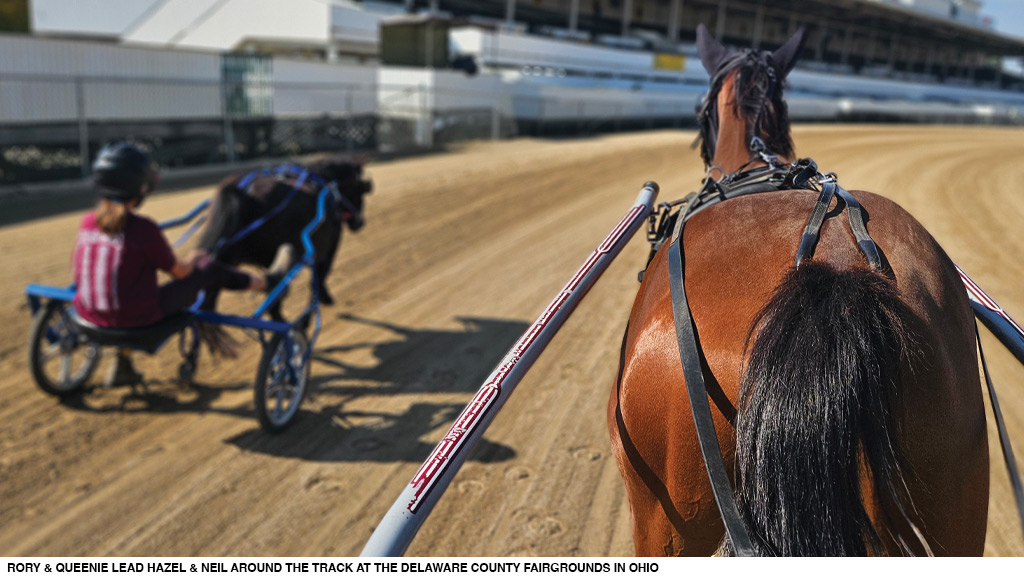
“When the four of us - Rory, Queenie, Hazel and I - took to the track to jog at the Delaware Fairgrounds one morning last year, Rory thought that was just normal. Ron Burke was going a training trip with Louprint at the time, and by the look on his face when he saw us I could tell that it wasn’t,” said MacInnis with a laugh.
“She got that stoicism from her mom. She’s cool under pressure.”
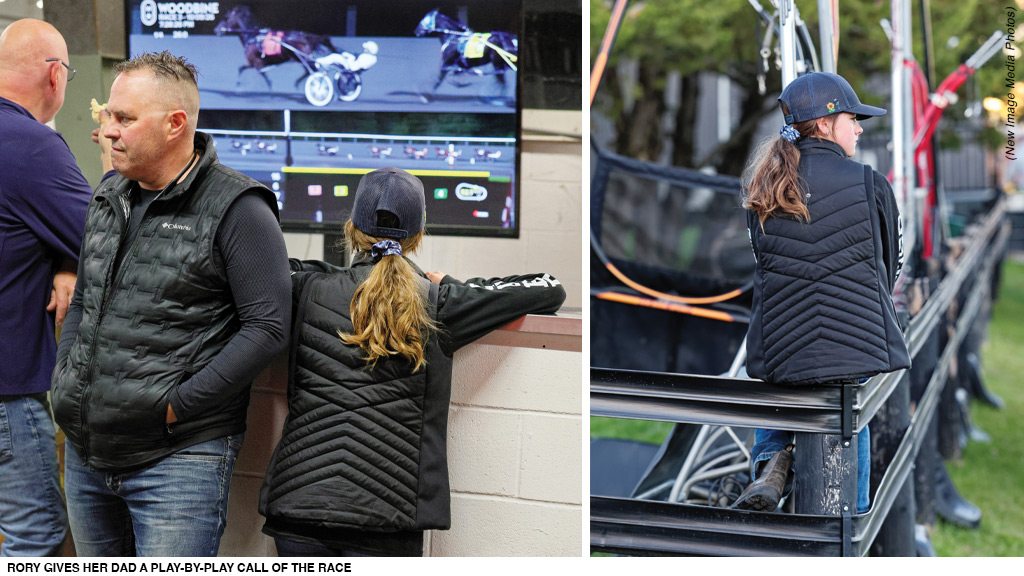
At other times, Neil will lean into the serious side of his daughter - the one that’s 11 going on 35 - particularly in those moments at the track when he can’t bear to watch the race. The fact is that Neil has never watched one of Hazel’s races with his own eyes, but looks the other way out of nervousness and relies on his young partner to keep him abreast of the events with her own verbal play-by-play call of the race.
“He’s always pacing. I’m always yelling at him to come and look,” Rory said. “I get why he doesn’t want to look… I’m nervous to watch too, but I’m also scared to miss the race. I always watch it, and I don’t really care what happens after. I just feel good going into it, and remember that maybe after you’ll think of something you can improve on for the next race.
“Even fourth is fine with me because she accomplished it,” Rory continued. “When she finishes back or breaks, we have to look into her harness, her management and her eating, and make sure she’s getting enough attention - which she demands.”
To hear an 11-year-old girl spout off the words you would expect from a seasoned trainer many years her senior might lead one to wonder if Rory is still finding time to embrace the life of a child. Fear not - that child is still in there. When asked what she’d like to be when she grows up, her reply immediately reflected on Queenie.
“I would love to breed baby ponies. I dream of being a breeder and watching little horses growing up to be something so cute,” Rory said.
This feature originally appeared in the November issue of TROT Magazine. Subscribe to TROT today by clicking the banner below.