


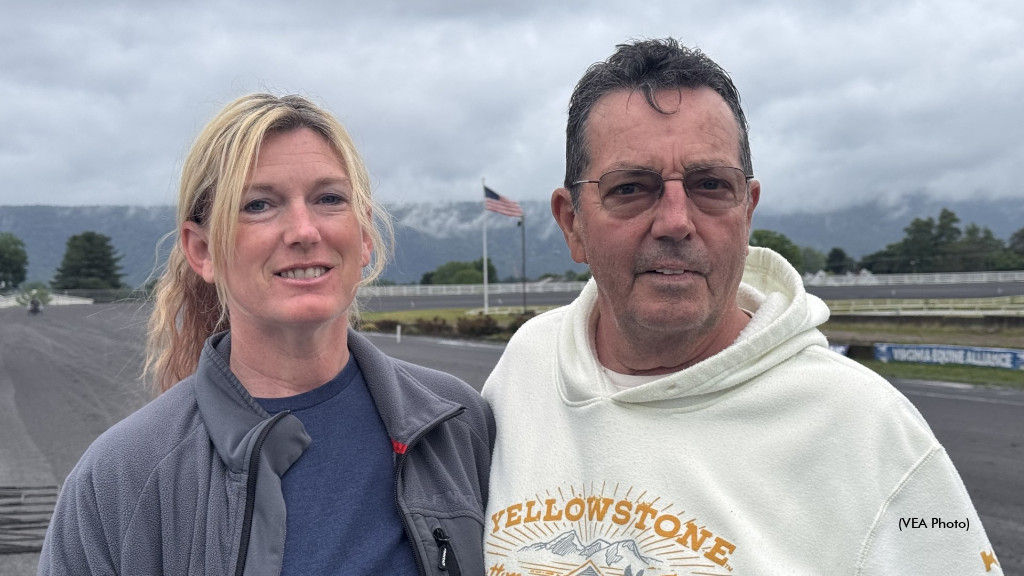
Gary Mills did not grow up in a harness racing family per se, but he has carved out a six-decade career in the business as a driver, trainer and most recently, as a track superintendent.
After becoming the youngest driver to reach 500 wins early in his career, Mills transitioned from riding over the track in two wheels and behind four hooves to tending to track surfaces in motorized vehicles that have four and even six wheels. After 2,500-plus trips to the winner's circle, Mills traded in his sulky and jog cart for a tractor, grader and pickup truck.
The 76-year-old currently serves as track superintendent at Virginia's Shenandoah Downs where he is preparing the half mile oval for the Virginia Breeders Fund "Day of Champions" card on Saturday, May 23. Three-year-old pacers and trotters of both sexes will compete in a four pack of $100,000 USD stakes.
Mills has spent the last two years in Woodstock, Va. with his tag team partner, Jamie Schooley — who works with Mills on the track crew and also serves as Shenandoah's Stall Superintendent. Mills previously had stints at tracks in the Midwest before moving east. He enjoys the thrill of seeing a horse do well whether he is in a race bike competing, or on a tractor.
"I drove a lot of horses for other people and had a fair share of my own horses too," he said. "It's satisfying to win when you drive and even more so if you train and own the horse. But when you see a good horse like Lous Starr set a track record time one week, then see him come back a week later and equal that time in the rain, that's enjoyable. As a trackman, I absolutely take pride in that kind of performance. I think we did a good job with the track that day. He's an exceptional horse."
Lous Starr is a Dan Chansky-owned four-year-old pacer who equaled Marco Beach's 1:51.4 track record mark on May 2 and did it again on May 9.
"From my years training and driving, I think I know what to look for in preparing and maintaining the track surface for the races, and how I want it to be. If a horsemen has other ideas, it's up to them to let me know. I have no problem doing what they want but so far it's worked out well. The track maintenance gig is good," he added. "We seem to fit in everywhere we go."
Mills grew up at a family cattle farm in Richmond, Ont. and got his first taste of racing at Rideau Carleton Raceway.
"We had one retired standardbred on the property growing up that I got messing around with. My dad ended up buying me a race bike, jog cart and harness all for $500," Mills recalled. "I trained that horse on a side road and tried qualifying him at Rideau Carleton but he had knee issues and that didn't work out. I left school at 17 and ended up going to work for Forest Wilson at Rideau Carleton and went out west with him. I stayed with Forest until the following year then worked for Ray Parker five years before venturing off on my own. From that point, I had success competing in stakes all over the country as far away as California. I did quite a bit of flying and driving,"
Mills first started driving and training at Louisville Downs. Parker was from Corydon, Indiana, which was only 35 miles away. "I got a fair license and won my first race ever at Corydon and won my first pari-mutuel race at Louisville."
Mills' initial circuit included Kentucky tracks — Louisville, Lexington and Latonia. In time he ventured to The Meadows and in the '80's, moved to the Chicago circuit.
As far as transitioning to track maintenance, Mills' family had a couple farms and both had tracks that he started to maintain with a grader. He then managed a training center in Crete, Illinois for 10 years. After that, he maintained tracks like Hoosier Park, Oak Grove, The Red Mile and Cumberland Run.
Mills met Schooley eight years ago and they have been a tandem since.
"I'm third generation on both sides," she said. "My grandparents both raced. My mom's side is from Iowa and they're still racing out there. My dad's side is from Indiana. My parents both moved to Kentucky in the '90's and stayed in the business. My mom and I maintained a stable and raced in the Illinois-Kentucky circuit but when they needed someone to work on the track, I said yes and started learning that part of the business."
"Bigger ovals require a bit more work," said Mills. "They tend to be wider. It probably takes five hours to grade a mile track where it might take 2-1/2 hours to grade a half-mile oval."
Asked if he is still a fan of the sport — years removed from driving and training — Mills said, "Absolutely. I still like horses. I'd buy one tomorrow. The sport has changed quite a bit. When I started, we were racing for $500 and there were $750 claiming races. Stakes races were not that prevalent. Nowadays, you can go for $500,000 all summer long. It's been quite an upgrade. There's been so many improvements in harness racing over the years, the biggest of which is the use of pylons."
Both Rideau Carleton and Balmoral Park played integral roles in Mills' career so the last month has been tough given the closure of the first and a recent fire at the latter — though Balmoral had not hosted races since December, 2015.
"Yeah, that the news has been unfortunate but at the same time, it's nice to see new racetracks coming on board," he said. "Oak Grove has been a nice addition along with Cumberland Run in Kentucky. And it looks like Illinois might have an opportunity again with a track in Decatur."
(Shenandoah Downs)