
A Grandfather’s Prophecy; A Young Driver’s Ascent



When the late Jerry Silverman took the podium for his Hall of Fame induction in Goshen, New York, in July 2019, he made a bold declaration that resonated through the room.
“There’s a young one to watch out for…” he said with unmistakable pride.
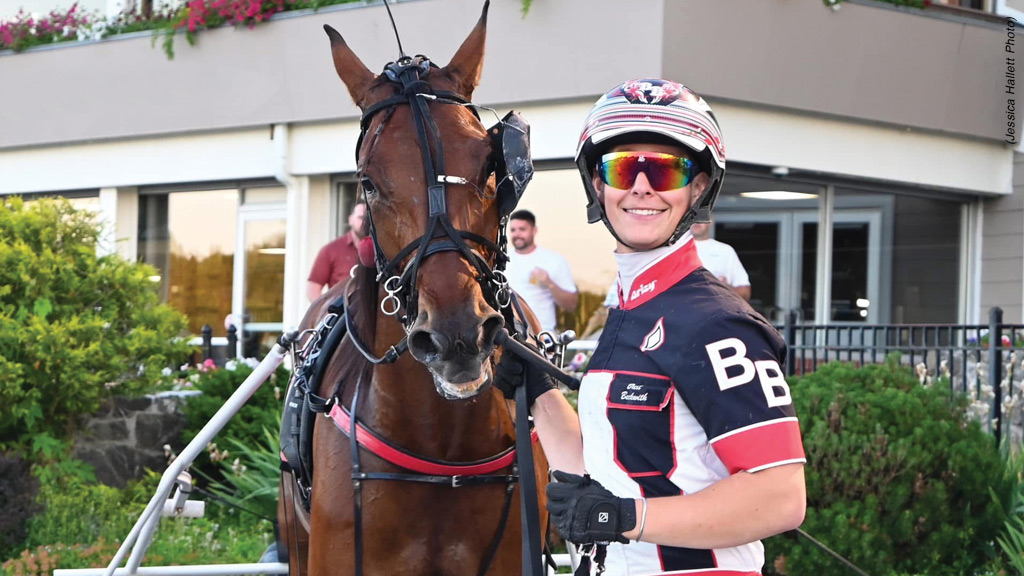
He was referring to his grandson, Brett Beckwith - just 16 at the time - who was embarking on his first year driving horses. Six years later, Brett isn’t just meeting those expectations; he’s surpassing them. Now 22, he’s emerged as one of the sport’s most promising young talents, carving out his own legacy while honouring a family tradition deeply rooted in harness racing. Jerry’s confidence was no mere encouragement; it was prophecy, and what once sounded like hopeful words now ring with the clarity of foresight. For Brett, his grandfather’s belief wasn’t a burden, it was fuel. A quiet determination took hold within him to be great, and to validate the faith that Jerry placed upon him. That belief didn’t cast a shadow over his path, it became a guiding light. The pursuit of greatness as a driver is demanding, stressful, and can take a toll both physically and mentally. It requires early mornings, late nights, relentless travel and unwavering mental toughness. And while Brett approaches each race with immense focus, those closest to him understand how easy it is to forget, that beneath the helmet is still a young man with a full life ahead of him. One who needs to remember to enjoy every moment of the ride - just as much as he steers it. By John Rallis.
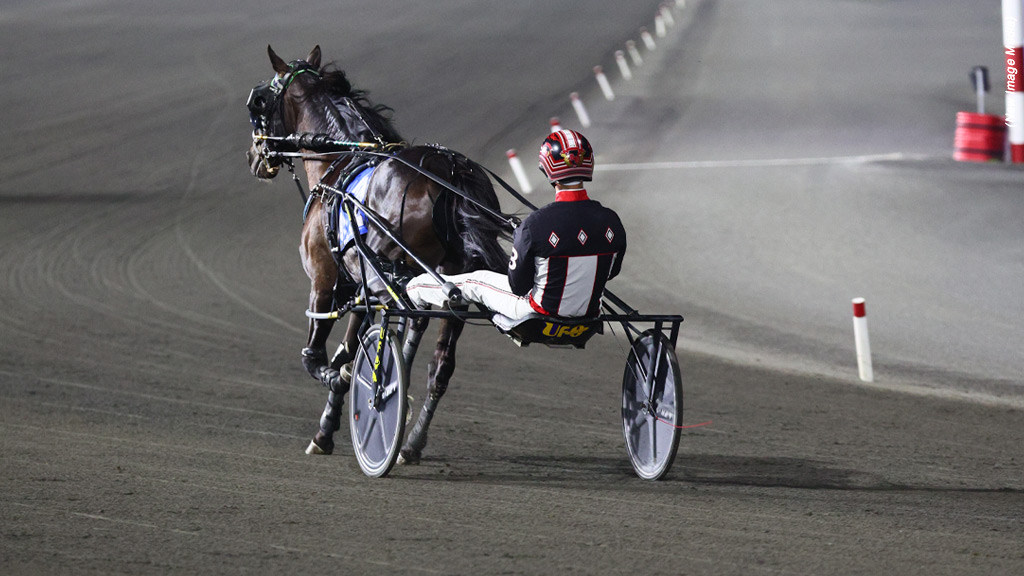
“You could say he had the brains, or the audacity, to say that at the Hall of Fame ceremony that year,” Brett says with a chuckle, recalling his late grandfather’s bold prophecy. “I’ve still got a long way to go, but I don’t think I’ve made him look foolish… at least not yet (laughing).”
So far, the early returns on Jerry’s statement have been more than promising. Beckwith is coming off a career-best 2024 season, shattering personal records with 608 wins and more than $8.5 million in purses. He also became the second youngest driver in history (21) to reach 1,000 career wins, and in February 2025, he took home the ‘Rising Star’ Award at the Dan Patch Awards in Orlando, Florida.
Though proud of the milestones, the young reinsman remains as driven as ever. He’s progressing, but never settling.
“I’m an extremist,” Brett admits. “Anything I dive into, I do it at one hundred and fifty percent, and that’s been the case from the moment I got into driving.”
Despite growing up in a family deeply rooted in the harness racing world - his parents, uncle, and grandfather are all heavily involved - there wasn’t an immediate pull inside Brett to follow suit. Between the barns, the backstretch, and the long days, it was all familiar, but not necessarily appealing.
“I was a nerd growing up,” Brett laughs. “I loved going to school, hanging out with friends, and playing lots of video games. Going to the barn was never part of my routine.
“With my family so immersed in racing though, I didn’t get to spend as much time with them as I wanted, and that started to weigh on me as I got a little older,” he explains. “If I wanted to be around my dad and bond with him more, it meant going into the barn. So that’s what I did.”
What started as a way to spend more time with his dad quickly turned into something more. The quiet bonding moments soon gave way to real responsibilities that come with the day-to-day of being at the barn: cleaning stalls, and jogging and grooming horses.
“It wasn’t long before I was fully in it,” Brett recalls. “One minute I was just happy to be hanging out with my dad, and the next I was out there every morning doing barn work and learning the ropes - without even realizing it. Like I said, I’m an extremist (laughing).”
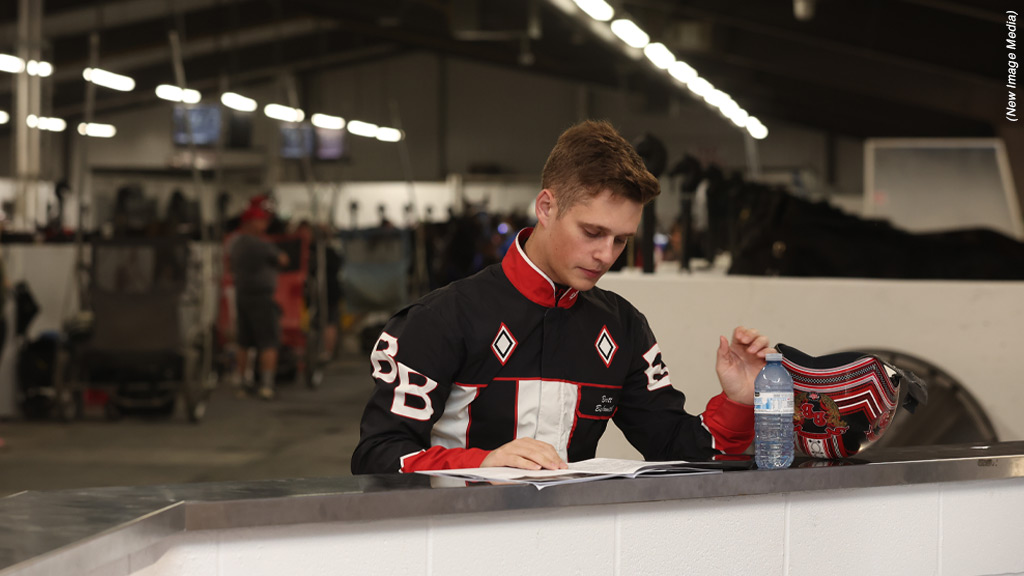
Those early mornings in Saratoga, New York - filled with cold air, the smell of hay and the rhythmic sound of hooves - began to reshape Brett’s routine, his perspective, and ultimately his future.
“I remember being in the grandstand with my grandfather, watching his horses compete,” reminisces Brett. “You could just see the thrill on his face… that’s also when I thought to myself that I’d love to give him that same level of joy, with him watching me compete.
“So after a few weeks of being in the barn [full-time], I said, ‘Alright, how can I get my trainer’s license… How many qualifiers do I need before I can get a driver’s license?’ I was committed.”
That all-in attitude wasn’t just instinct, it was inherited.
Brett had a front-row seat to what real commitment looked like through his father, Mark Beckwith, a respected name in harness racing long before Brett ever thought about lining up behind a gate, and a man who had worked through plenty of obstacles to get there. Mark never took shortcuts in his career, grinding vigorously in more ways than one, until he earned his place as one of the most consistent and respected horsemen in the game.
”My dad lived in his car for two years when he worked for Ray Schnittker back in the day,” shared Brett. “He couldn’t afford a place to live during his early days in the industry, and he went through some unimaginable struggles… Fast-forward twenty-something years later, and he and my mom are atop of the trainer standings at Saratoga. Watching my dad operate on a day-to-day, knowing what he endured on-and-off the track, motivated me to want to succeed.”
Mark Beckwith, and Brett’s mother, Melissa, have combined for 2,991 training wins and more than $22.1 million in purses over their careers, but even with the name and the access, the aspiring reinsman still had to earn his stripes. Nothing was handed to him, not even from his own parents.
When Brett began driving, he did so with confidence in his ability, certain that if he put in the work, results would show. But while he was ready to prove himself, his father, Mark, was quietly wrestling with a different kind of pressure.
“He was nervous [for me],” Brett admits. “Not because he didn’t believe in me, but because he didn’t want to see me fail and be bad at it. My uncle [Ritchie Silverman] and my grandfather were the ones who were more gung-ho in terms of their excitement level of me pursuing a driving career.
“Look, at the end of the day, my dad had owners he had to please, and he had built a successful operation from the ground up… The last thing he needed was to feel obligated to put his son down to drive, and have me be the reason that his success started trending the opposite way.
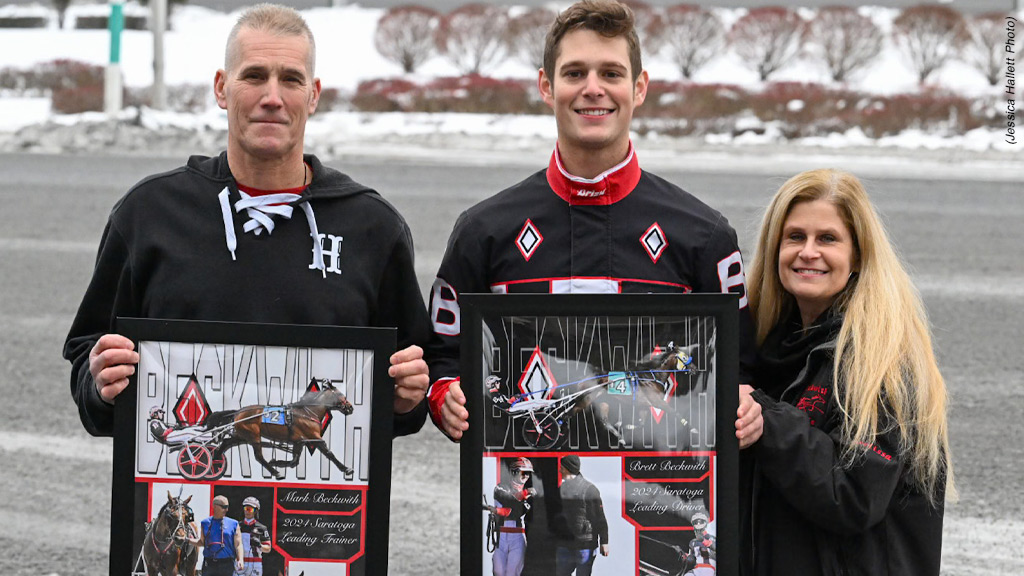
MARK & BRETT, ACCOMPANIED BY MELISSA, ACCEPT THEIR AWARDS FOR 2024 TRAINER AND DRIVER OF THE YEAR, RESPECTIVELY, FOR SARATOGA CASINO HOTEL.
It wasn’t just that, Mark Beckwith had seen how unforgiving the sport could be. He knew talent alone didn’t always translate, and that it doesn’t take much to get swallowed up by the moment.
“I think, for him, it was hard watching from the outside,” Brett continues. “He’s my father, so of course he wanted to support me, but he also knew there are no guarantees in this business, no matter your last name.”
Along with being a successful trainer, 59-year-old Mark Beckwith is also the winner of 5,902 races and more than $33.5 million in purses as a driver. A winner of 100 or more races every year but four between 1992 and 2019, Mark wasn’t exactly used to handing the lines to a catch-driver either.
“Just because I was a ‘Beckwith’, my dad didn’t automatically list me on his horses when I started out my driving career,” shares Brett. “He wanted me to earn that right, the same way he did.
“Funny enough, I found out just recently that my dad had a conversation with Yannick [Gingras] regarding what he could do to help with my career [when I first started driving], and what kind of approach he should take with me driving for him. I almost found it to be more pressure driving for my dad early on, but I’d say it’s worked out (laughing)”
In 2024, the father-son tandem of Brett and Mark Beckwith silenced any lingering doubts either may have had - both internally and externally. The pair teamed up to become the leading driver-trainer combo at Saratoga, a milestone that brought both personal and professional pride to both sides of the relationship.
“To be able to do that with my dad - it means everything,” Brett said. “There was a time where he probably didn’t know if I’d be any good at this, so to share that with him was special.”
That milestone moment Brett shared with his dad was a defining highlight in what turned out to be a spectacular year professionally, and as Brett’s numbers soared, so did his reputation. He was becoming more than just a promising name, and with that rise came new conversations, not just about where he was, but where he was headed.
“The last couple of winters, myself and some other young drivers have been competing at The Meadowlands, while the top guys have been taking their annual vacations,” stated Brett. “It’s a good opportunity for us to get a sense of what competing there is like, because at the end of the day, that’s where we all want to be.
“After the year I had [in 2024], I spoke with people close to me and they said I should stick around on the weekends [at The Meadowlands] all year long. I figure it could come with some risk and plenty of struggles, but I’m determined to take the next step as a driver.”
Now, however, through mid-July, Beckwith sits alone atop the driver’s standings at The Meadowlands, an accomplishment he’s undoubtedly proud of. But as the wins accumulate and the spotlight grows brighter, so too does the silence between the cheers, serving a quiet reminder that success, for all its glory, doesn’t always fill the spaces it can leave behind. At the top, it can get lonely in ways that aren’t always obvious, and not always easy to talk about.
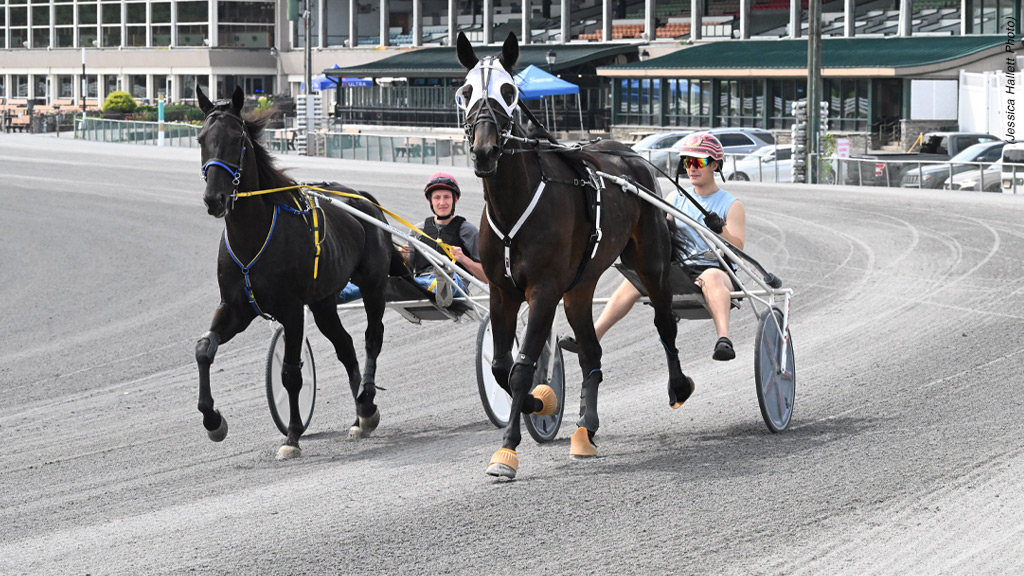
TREVOR (L) AND BRETT IN THE RACEBIKES AT SARATOGA
“I set such an extremely high standard for myself both personally and professionally, that it can be a heavy burden on me mentally and emotionally at times,” admitted Brett. “Even if I look up and see my name at the top of the driver’s standings [at The Meadowlands], while I’m proud of the feat, I’m always micro-analyzing any mistake I’ve made [on the track] or concentrating on some of the bad beats. Those kinds of things can really eat you alive.
“Truthfully, there’s no blueprint on how to handle things like that. There are stretches where I’ve become so accustomed to winning six, seven, or even eight races a night, which is great, but then I’m determined to do it over and over and over again, and those expectations are very unrealistic. When the lull periods hit, I have an extremely difficult time navigating through it.
“It’s why I respect so many of the top guys, who can endure a tough beat in a signature stakes race. Some of these guys can go through an excruciating beat, come off the racetrack and still conduct themselves in a manner as if they were the ones getting their picture taken. You always hear the term, ‘Turn the page’, and that’s still something I’m trying to deal with.”
Conversations about mental health rarely come to the forefront in harness racing, and even less so when it comes to young athletes. The focus is often on numbers and results, and never on what’s going on behind the scenes. But for Brett, focusing on that aspect has quietly become just as important as the races and results themselves, especially considering what those close to him have had to endure in their lives as well.
“Mental health is real, and it’s no joke” stated Brett, “and nobody has been affected by it within my family worse than my dad has.
“My grandfather, Bert Beckwith, who was a respected horseman in New England, took his own life when he was 42-years-old, when my dad was just 21-years-old. Years later, my dad had to unfortunately go through something similar again, when my half-brother took his life at a young age as well.
“It was a major struggle for my dad, having to endure what he did with those two losses in his life, both coming to suicides, no less. To see him rise above that when he had every reason to fall into a dark place and stay there, is extremely motivating to me. That, to me, is true perseverance, and far greater than anything I’ll ever be able to accomplish on the track.”
Success doesn’t shield you from stress, and the thought that it may disqualify you from feeling depressed is a notion Brett believes needs to be expelled from the culture of the sport. “Just because things look good on paper doesn’t mean everything feels good inside all the time,” he stated.
It’s a misconception that runs deep, especially in high-performance environments where results are often mistaken for well-being. But Brett is learning, and hopes to motivate others, that it’s okay to acknowledge the mental weight, even when the wins keep coming.
“‘What do you have to be stressed about?’ is something I hear far too often,” he shrugs. “Don’t get me wrong, I’m pleased with where I’m at professionally and how things are progressing, but wins and losses don’t define how a person feels, nor who they are as an individual.”
Brett knows that no matter how fast you’re going on the track, it’s the pace of life off of it that can ultimately make or break you. Few understand that better than former jockey Trevor McCarthy, who has been candid about his own battles with mental health throughout his riding career.
Over a number of weeks in June and July, McCarthy had been spending mornings at the barn with Beckwith as they prepared for their charity match race, which was set for Saturday, July 26 at Saratoga (harness). Now 30-years-old, McCarthy has stepped away from riding Thoroughbreds, but remains a vocal advocate for mental health, working in partnership with the Horseracing Integrity and Safety Authority (HISA) and the Jockeys’ Guild. He continues to bring awareness to the often-unseen struggles within the sport, and for Brett, he’s been more than just a training partner - he’s been a steady presence, someone who truly understands the mental toll that comes with life as a driver.
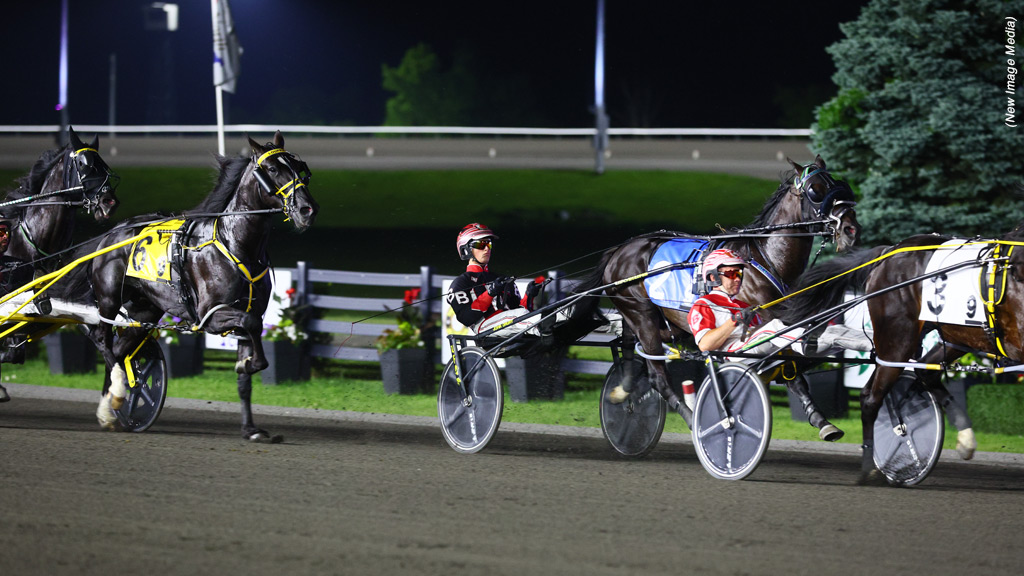
“I see a lot of myself in Brett,” says Trevor. “I had a lot of success in my early years of riding, and I wanted to take that next step, in terms of wanting to compete at a more elite circuit.
“I did okay, but it’s a very difficult transition. You get so used to winning, and with that comes a real high, a deep desire to keep winning. But when the opportunities don’t line up it can take a serious toll on your mind. You’re doing everything you can, physically and mentally, to be ready, but when things start to spiral, we [jockeys] tend to take all the blame.
“For me, I had to endure a lot, physically, just to maintain my weight. And I see him where I was in those early stages. He’s constantly on the road, whether it be Plainridge, Saratoga, The Meadowlands… Pulling double-headers and racing seven days a week. I’ve told him many times: ‘Yes, it’s good to be driven, yes, it’s great to have goals, like finishing top-five in the standings every year, but your mental health has to come first’.
“Over time, I felt the burnout from riding nonstop. I endured the constant grind, and even realized that the success was never enough. If I won 250 races, I would need to reach 260 the next year. It becomes this chase for something that doesn’t really exist. And at what expense? You want to be able to enjoy these steps, to be present in these moments, but also find a balance. That’s what I’ve been trying to remind him of.”
Brett deeply values Trevor’s advice, along with the guidance of those around him who have helped shape not just the driver he’s become, but the person he is today.
The young reinsman doesn’t take that support system for granted. In fact, he credits much of his success, and his ability to stay grounded through it, to the foundation he has surrounding him. It’s a circle of family, mentors, and friends who remind him of what truly matters, even when the wins, and the resulting expectations, pile up.
“I wouldn’t be where I am today without my support system, that I know for certain,” stated Brett. “Everything I’ve done, I owe it to hard work and dedication, but you can’t do it alone, there are countless people who have helped along the way, especially my mom and dad.
“I’m always smiling, and for good reason… I have plenty of reasons to be happy. I love what I do, I get to share my experiences with my family, and I even get to travel across the world [to New Zealand] to represent my country later this year to compete in the World Driving Championship, an experience that I’m very much looking forward to… I owe it all to the sport of harness racing.”
As he makes the three hour trek back home from a winless evening at The Meadowlands, those uneventful nights remind him that while his stat sheet may sometimes look bleak, it’s certain other qualities that truly matter.
Reflecting quietly on the prophecy his late grandfather Jerry made years ago at the Dan Patch Awards, Brett stands as a living embodiment of another family figure, his late grandfather Bert, whose name was lovingly rearranged to give Brett his own.
A name doesn’t define who you are - your actions do. And as motivated as Beckwith is to live up to his name - for himself and for others - he’s beginning to understand that in life, going slow quarters is sometimes perfectly fine too.