
Faces Of Racing: Mona Legge


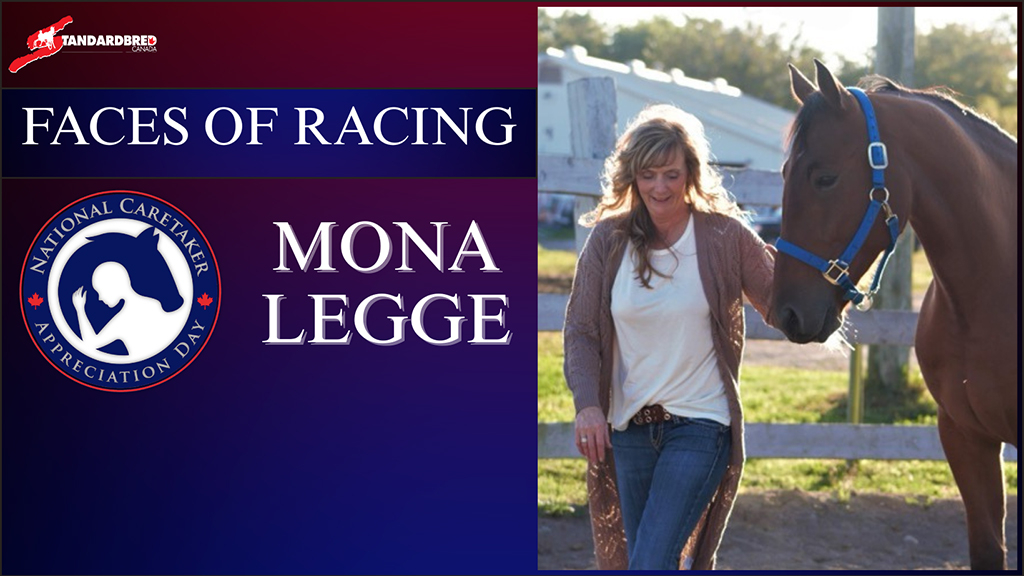
As 2026 National Caretaker Appreciation Day events presented by Standardbred Canada in collaboration with racetracks, associations and industry partners continue across the country, Standardbred Canada's Faces of Racing series shines a spotlight on the people who dedicate their days to caring for the horses at the heart of harness racing.
For most horsepeople, their introduction to the sport comes through their parents. For Mona Legge, the story came about in reverse order. It was her son, Keith, who opened the door to the sport for his mother.
Twenty-five years ago, when Keith was just four years old, he began spending time around racehorses with the family's babysitter, Dixie McKay, in Bottle Hill, N.S. What started as a young boy's fascination with horses quickly became an obsession and, before long, Mona found herself getting involved, too.
Mona was no stranger to the farm when Standardbreds first found her. She grew up on a family farm in Nova Scotia, where her father, a Nova Scotia Power lineman, kept a small herd of beef cattle and draft horses used for logging. She was well-versed in caring for livestock when she followed her son into the sport.
“He started going there and his addiction with the horses and harness racing started, and then I got involved just by being around with him and Dixie,” recalled Mona. “I just assumed that he would move on from it, but he just kept getting more and more involved, almost like challenging himself, too. So, of course, I was right along for the ride with him, and it's been incredible.”
Realizing they were both hooked on harness racing, Mona decided to get her first horse.
“It was like, ‘We should have our own,’” recalled Mona.
So, she partnered with a friend on her first racehorse and hasn't looked back.
“We shared our first horse together, and then we got another one, and then just as time went on I got more and more involved, and then Keith was more involved, which got me more involved, and then it just ballooned,” she said.
Mona got so involved that she allowed the sport to bring her west, as many do. After visiting Keith while he was in Ontario working in the industry, Mona decided to make the move and give the Ontario circuit a try. She spent time working with Patrick Shepard and Corey Johnson while in Ontario, gaining experience and learning different caretaking techniques before returning home to Nova Scotia after the COVID-19 pandemic began.
Upon her return, Keith had already moved home himself and was working toward his trainer's license. The two paired up and began a small stable together.
Today, the mother-and-son team has two horses. Their operation may be small, but the commitment is anything but.
Their mornings begin between 5:30 and 6 a.m., with Mona taking care of the indoor work while Keith handles the jogging. Both work full time outside of racing, Mona as an administrative assistant at a local salon and spa and Keith as a powerline technician at Nova Scotia Power, so their days require plenty of organization and dedication.
For Mona, that dedication means making multiple trips to the barn each day before eventually heading home in the evening, though she wouldn't trade the commitment for anything.
“I just find it very rewarding that we work with our own,” she said. “It's neat that we can care for, train and drive our own.”
Keith sees that commitment firsthand.
“Number one is dedication,” said Keith. “You know the old saying when people say the horses eat before we eat? Well, that's the way she rolls 100 per cent. She's there at 6 a.m. every morning, and she literally goes back three to four times a day, three minimum. And the last time is usually 8 o'clock at night, and tucks them in with their bed lunch.”
Having his mother alongside him has become just as important as the racing itself. Every morning, after they feed the horses, the pair sit down together for a coffee at the barn.
“That's our time, our thing, and we both love it,” said Keith.
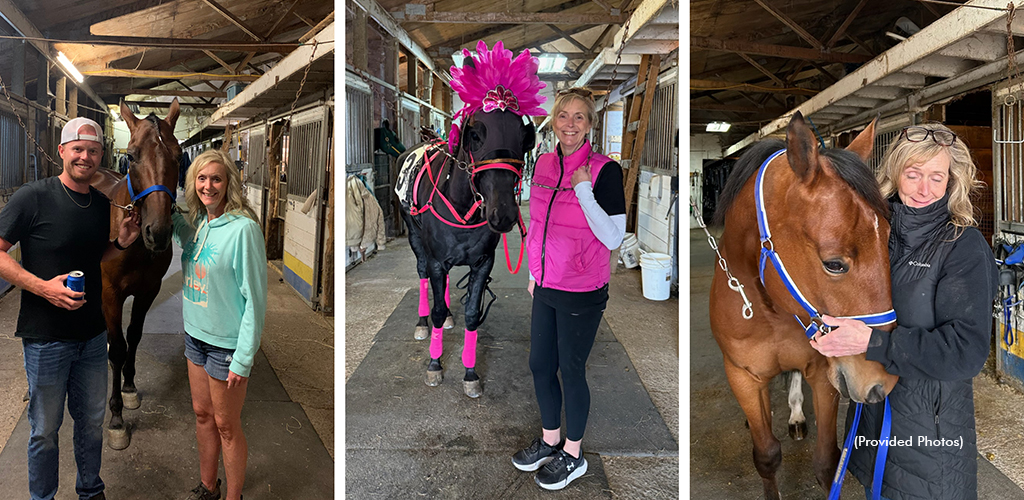
For Mona, her most memorable horse is Crafty Xample. She had worked with the gelded pacer while she was in Ontario, and when friends later bought him in Nova Scotia, she stayed in touch. When "Crafty" suffered a fractured cannon bone and was not expected to race again, Mona reached out to her friends.
“I was like, ‘I want him.’ I was just going to give him his forever home, you know,” said Mona.
Crafty Xample spent 15 months on stall rest recovering, then something unexpected happened. One day, while Mona had "Crafty" out of his stall to clean it, the horse leaned into a harness hanging nearby and it fell across his back.
“Is he trying to tell us something?” joked Mona.
So, they decided to take him for a walk.
“And he never stopped,” said Mona. “Each day he kept going further and further, and it ended up we got him back.”
Crafty Xample raced for a year and a half following his rehabilitation and added two victories to his career total.
“He kept going, and then when he said he was tired and didn't want to do it anymore, we stopped,” she said.
However, Crafty Xample's purpose during that final stint of his racing career was much greater than individual accolades.
“Keith actually used him in the amateur races and won both times. And used him for his qualifying drives to get his driver's licence,” said Mona. “There you had Keith, who was just starting out, and then you had a horse that was supposed to have a career-ending injury.”
Crafty Xample is now retired, though Mona gets to experience the sport from two perspectives: as a caretaker watching her horses give their all and as a mother watching — and worrying — as her son pursues the sport he has loved since he was four.
For Mona, her favourite part of harness racing comes down to one thing.
“For me, I have to say doing it with Keith and watching him excel,” she said.
That feeling is shared by Keith, who knows how much his mother has invested in both the horses and his career.
“She’s been my ride or die. I wouldn’t be here if it wasn’t for her on so many different levels. I can’t even put it into words, to be honest. She’s the backbone of this stable and I don’t think there’ll ever be a time where we don’t have a horse in our lives, or we’re not doing it together.”
And after 25 years in the sport, Mona's advice to younger caretakers reflects the same commitment to learning that has shaped her own career.
“You can never stop learning,” she said. “There's always so much more to learn and so many more techniques.”
She encourages young caretakers to work for different trainers, learn different approaches and use those experiences to develop their own program.
“Everybody has a different style,” she said. “Definitely take other people into consideration and the way they look after horses.”
Mona Legge came into harness racing because her four-year-old son couldn't get enough of horses. Twenty-five years later, that childhood obsession has become a shared family venture. She has built her own connection with the horses and found fulfillment in being a caretaker, all while watching her son grow from a horse-obsessed little boy into a trainer and driver in his own right. A unique story on its own, but another fitting example of how harness racing can become a family affair.
The 2026 National Caretaker Appreciation Day celebrations continue across the country, with upcoming events at Kawartha Downs on Saturday, Oct. 3 and The Raceway at Western Fair District on Friday, Nov. 6.
To find out when National Caretaker Appreciation Day is coming to a racetrack near you, visit the National Caretaker Appreciation Day event page for the latest event information and updates.
(Standardbred Canada Press Release)