
SC Rewind: Clint Hodgins, Part Two


This week's edition of Rewind is Part Two of the Clint Hodgins story. The first part appeared in an earlier Rewind in June of this year. Robert Smith recalls some highlights and accomplishments of this late horseman, who enjoyed a very long career in the sport, spanning several eras.
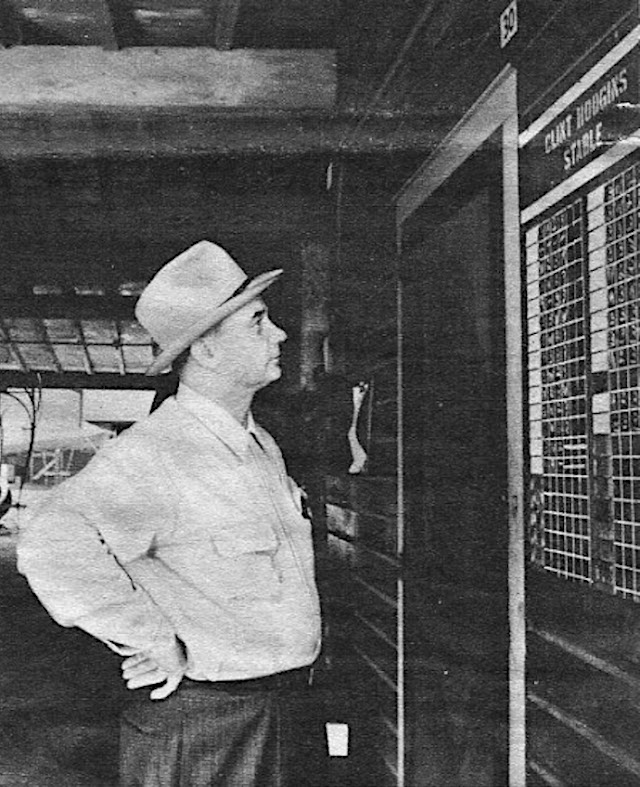
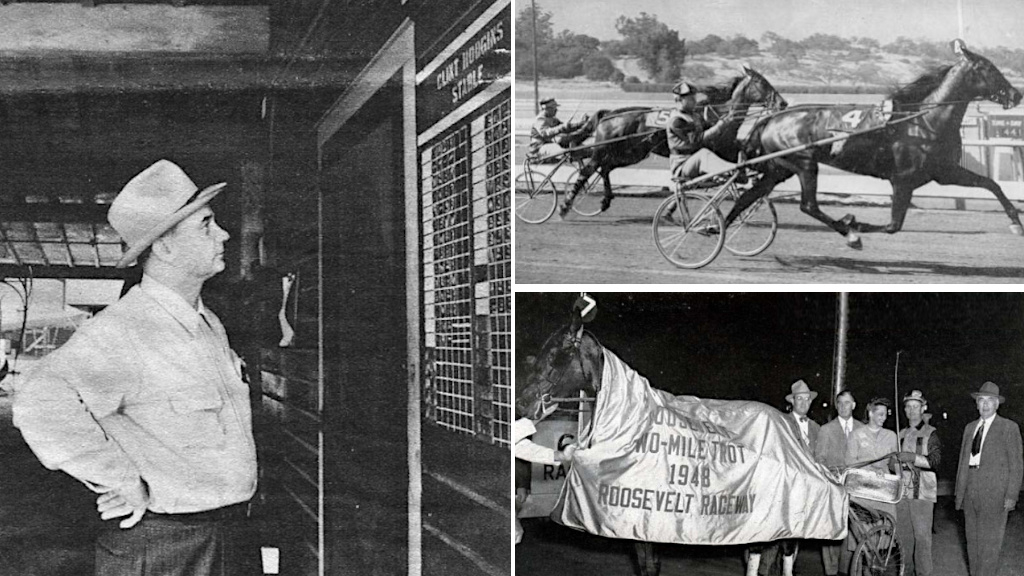
Clint Hodgins, who was a great trainer as well as a superb reinsman, is shown surveying his stable roster in this 1959 photo. (Author's collection)
Clint Hodgins was born in 1907 near the small village of Clandeboye, Ont., and raised on the family farm, where his father dabbled in harness horses. Young Clint developed an interest in the sport, which was then mainly a hobby for most participants.
His first experience was gained at local small-town tracks, where he soon attracted individuals seeking his driving skills as a catch driver. He drove for people such as Earl Rowe and Thomas Saint, both well-established owners.
At a fairly young age, he left Canada and accepted a job with a man named Henry Warwick in Cleveland Heights, Ohio, managing his stable for $150 a month. At this time, during WWII, he won a number of weekly prizes at Saratoga Raceway, which consisted of a $25 War Bond. From here, he slowly climbed the ladder of success, eventually winning nearly every major race in harness racing.
He remained a truly humble man and, for many years, did not even own a house, preferring to live in a tack room wherever he was racing. Perhaps his one "luxury" in life was driving a Cadillac, which at one time he replaced each year. This was quite a departure from his very early days, when he often hitchhiked to small-town racing spots.
Proximity Known as "Queen of the Trotters"
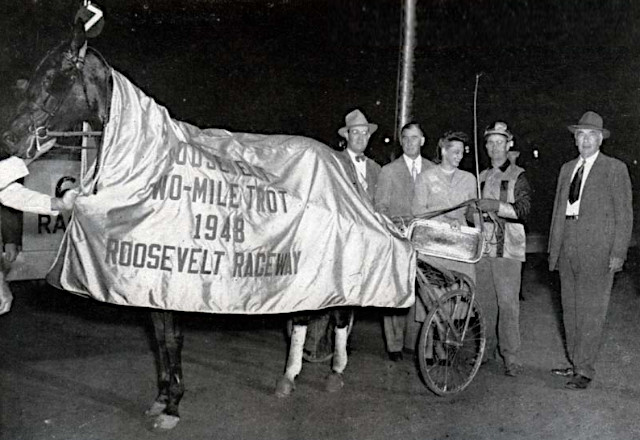
PROXIMITY is shown in her beautiful new blanket received following a TWO-MILE victory in "The 1948 Roosevelt Trot." From left, Walter Gibbons, Race Sec.; Robert Johnson, Roosevelt Pres.; Elizabeth MacDonald, authoress; driver Hodgins; and, on the far right, co-owner Ralph Verhurst. (Harness Horse)
At this time, Proximity was the most popular trotting performer in the sport by any standard. During the 1948 season, she earned $52,500, pushing her lifetime bankroll to over $101,000. She raced from coast to coast, thrilling huge crowds wherever she appeared.
She not only raced against all of the best trotters of the day (many were male performers), she also appeared in time trials on both half-mile and mile tracks that year. The highlight of the season occurred at Lexington in the fall, when she took her lifetime mark of 1:59.3 in a time trial, with, of course, Clint Hodgins driving. She had earlier trialed in 2:03 at Roosevelt. At this time, there were only five trotters designated as "Free For All," meaning they had won over $50,000 lifetime (and were currently active).
Despite the strong Canadian connections to Proximity, mainly through her first trainer Floyd Milton and later Clint Hodgins, she never appeared in a race on Canadian soil. However, in 1950, which I believe was her final year of racing, she was brought to Stratford, Ont., for an exhibition performance, at which time she set a new track trotting record of 2:06.4. Upon retirement at age eight, she had earned an incredible $252,000 in an era of small purses. Her lifetime earnings total established a new record, erasing one that had stood for 73 years. That record belonged to Goldsmith Maid, whose racing career was all in the 19th century.

Proximity and Clint Hodgins - 1948
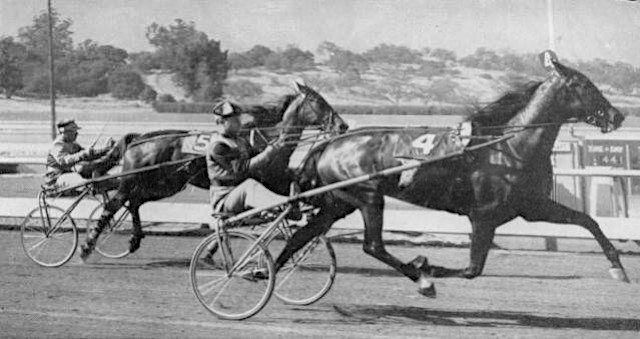
Proximity is shown in her winning form at the Arcadia, California, track in 1950. Her driver, Clint Hodgins, was a long way from his Canadian birthplace and the days when he first rode horses at the fall fairs near his home. In the beginning, he hitchhiked to the fairs; now he drives a Cadillac. (An excerpt from a Hoof Beats article.)
Proximity appeared on all of the great stages of her time and, in most instances, vanquished her foes. In 1950, she won the prestigious "Harness Horse of the Year" award in a unanimous vote, becoming the first mare to win that honour. Not too many horses are so dominant at the end of their racing career.
Her heroics at a time when the nation was in the healing process following WWII did wonders for the sport. She became a unifying symbol of strength and hope for the future. The mare's owners, Ralph and Gordon Verhurst, were from a small town in New York State named Victor, not far from Rochester. Proximity's fame was said to have brought great recognition to that area.
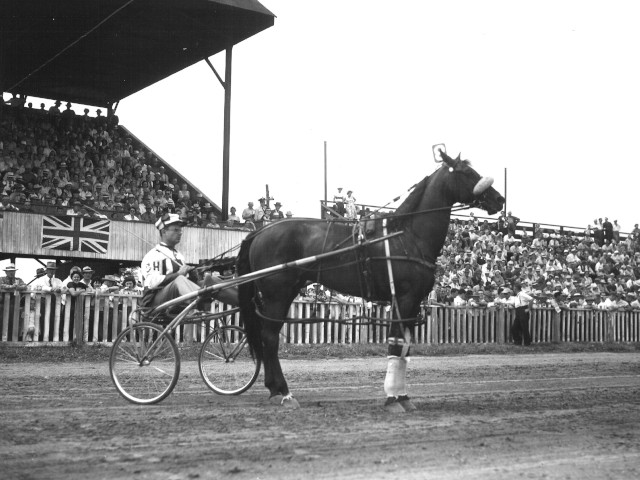
Clint Hodgins appears in the Stratford winner's circle after a win behind the locally owned Now. A huge crowd is evident in the background. (Photo from London Free Press Collection - D. B. Weldon Library)
On the afternoon of Aug. 2, 1954, another great race day was held in front of a huge crowd at Stratford, Ont. On this day, famed horseman Clint Hodgins, originally from Clandeboye, Ont., was on hand as a special guest. He was a longtime friend and business associate of Mr. Pinkney, undoubtedly making the appearance as a special favour to the race-day organizer.
Despite the fact that the majority of Clint's career was in the U.S., he often returned to his native Canada either to race or to visit lifelong friends. As covered in Part I, he made a triumphant return to the very area where his career began when the Ontario Sires Stakes started in 1974.
He campaigned just two colts, Terry Parker, a three-year-old, and Pats Bye Bye, a two-year-old. They both finished that inaugural season at the head of their respective classes in money earnings. He showed that he still had what it took to be prepared and also to win!
Over the years, a number of young horse people became part of the Hodgins stable, and what a learning experience it was. One of Clint's most famous protégés was the great French Canadian horseman Lucien "Loosh" Fontaine. Once, when asked about his time spent with Clint, he said, “I was scared of him because what he said went. I think that attitude produced good racehorses and good staff.”
He also tutored others, such as brothers Bud and George Gilmour and Maurice Pusey, who claimed they couldn't have learned from anyone better than "the master." When a reporter once asked, "And who did Clint learn from?" he answered in a fashion that revealed his usual dry, wry wit:
"Hell, just about everybody, from a drunken groom to all the top drivers in the sport. You know, I started caring for horses when I was six years old, but I didn't drive 'til I was 21 in Ontario. I didn't drive in the States until the mid-thirties, and I finally moved there permanently in 1939."
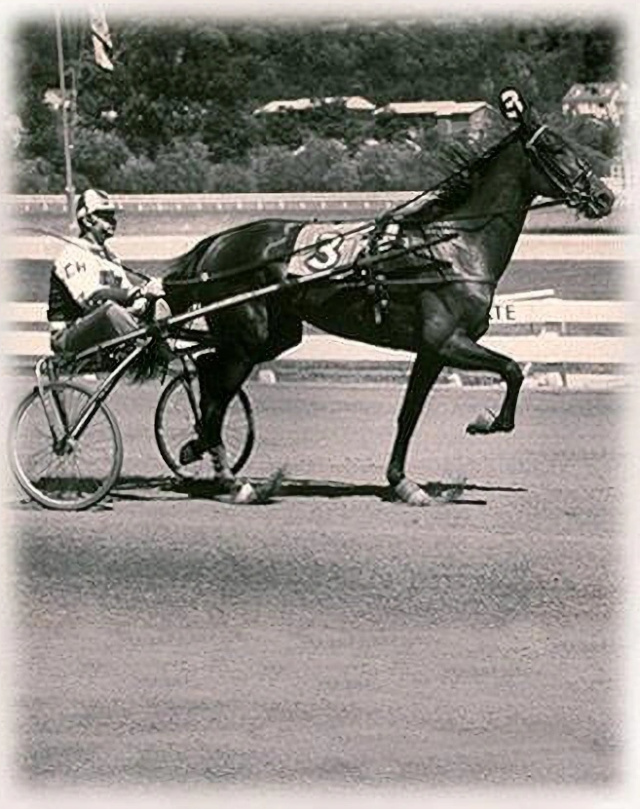
Elaine Rodney with Clint Hodgins in the sulky. This was just one of many fine horses he trained and drove that eventually reached Hall of Fame status.
Clint won his fair share of big-time races, including the Little Brown Jug in 1959 with Adios Butler. That year, the race went for its highest purse in its then 14th year, when $76,582 was offered. This year also marked the first time ever that a winning mile was clocked in sub-2:00 time. Their time was 1:59.2 over the Delaware half-miler.
However, he did not ever win the Hambletonian. In 1960, many observers believed that he had a pretty good chance in that year's classic. Coming into action on Hambo day at DuQuoin, his hopeful Elaine Rodney had a win streak of six on her résumé. She had performed admirably at both two and three, but she came up short that day.
That day did not work out, and she ended the afternoon with a standing of 2-3-6 and did not qualify for the fourth and final. That race took four heats to decide the winner, which was Blaze Hanover, U.S.-owned but driven by Canadian Joe O'Brien. She did win that year's Kentucky Futurity about a month later and, in so doing, set a new stakes record of 1:58.3. She became the world's champion three-year-old trotter that day, trotting the fastest two heats in history.
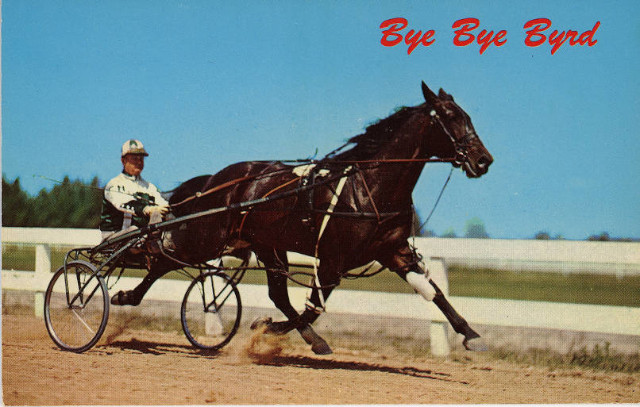
Clint Hodgins and Poplar Hill Farm's Bye Bye Byrd, one of the all-time greats in pacing history. A postcard was created to honour this great horse, who accumulated so many records. He was trained and driven throughout his illustrious career by Clint.
Throughout his lengthy career, Clint trained and drove a lot of great horses, but he always said his favourite was Bye Bye Bird, not a bad choice. In those days, most horses had longer careers and compiled records at various ages.
He never married but kept close ties with friends and family near his birthplace. When he died in a London, Ont., hospital in 1979 following complications from a stroke, he reportedly left some 1.5 million dollars for philanthropic causes, mainly in his home area. He was 72 at the time of his passing.
The following is a press clipping that appeared in newspapers across the land at the time of his passing:
LONDON, Ontario, Oct. 22, 1979 (AP) — Clint Hodgins, a member of harness racing's Hall of Fame, died last night after a long illness. He was 72 years old.
Mr. Hodgins retired from driving in the mid-1970s but remained active in harness racing as an owner. As a driver, he won 1,808 races and $6,271,318 in purses. In 1949, he was the nation's leading driver in victories, with 128, and purse money won, $184,108.
Quote For The Week: A short story involving this week's subject.
Clint Hodgins often liked to use just one name when naming his horses. The story is told that he wanted to name a yearling "HARRY." The person in charge at the CTA office contacted him and asked, "Harry what?" He replied, "Just plain Harry." So when the registration papers arrived, they said JUST PLAIN HARRY! Apparently, a few others were Ruthie, Grant, Rortey and probably numerous others.
Who Is It?
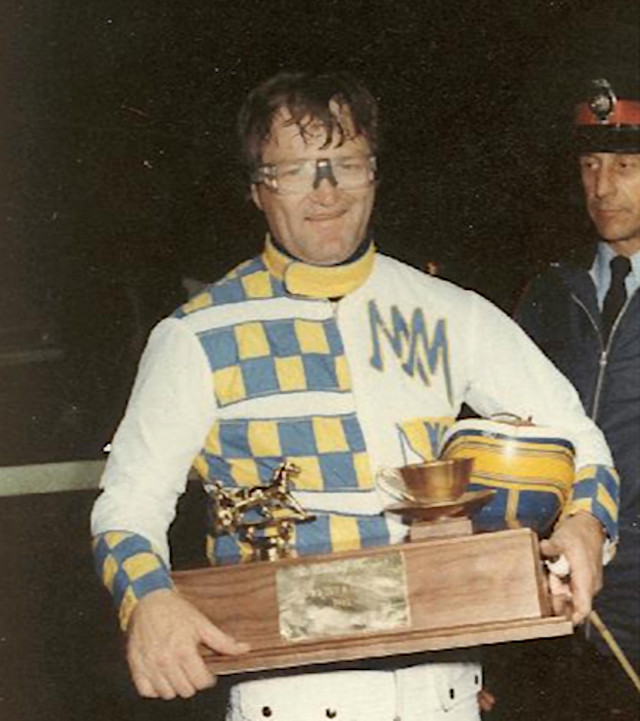
Can you name this fellow who was a five-time winner of a now pretty well-known race?
Who Else Is It?
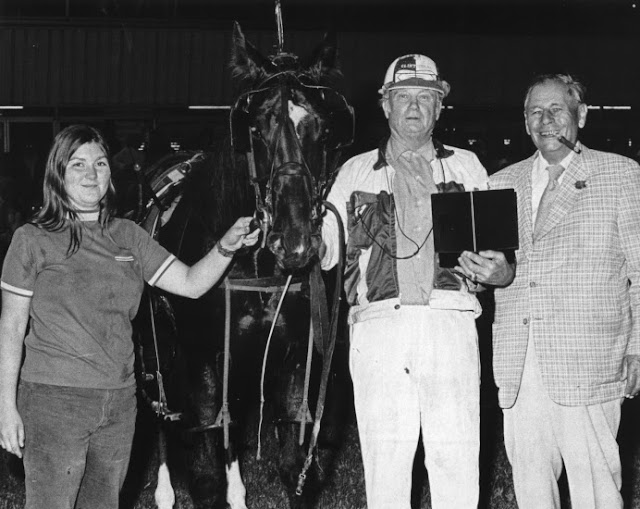
Can you identify any or all the folks in this 1974 photo?
(The correct answers will be posted here by Robert as a comment in a few days.)
This week's picture answers
Our experts had a pretty easy and light week. In the who is it? photo was Maritimer, the late Mike MacDonald following a Gold Cup & Saucer win. He had five. In the who else photo was driver Clint Hodgins, this week's subject. He is joined in the winner's circle by Elgin Armstrong of Armbro fame on the far right. The groom of winning horse Pats By Bye was Pat Belore (Harris) on the left. Thanks for your participation this week and always.
Who is it? Mike MacDonald…
Who is it? Mike MacDonald.
Who else is it? Pat Belore-Harris holding Pats Bye Bye with Clint Hodgins and Elgin Armstrong.
Who is it Mike McDonald …
Who is it Mike McDonald Who else is it Clint Hodgins Elgin Armstrong