
Western Dreamer: Absolutely One of a Kind


A Triple Crown winner is usually expected to have a lasting impact on the breed by shaping future generations of racehorses via the breeding barn, but instead, Western Dreamer, who became the first gelding, and just the eighth pacer overall at the time to accomplish the feat, in 1997, cemented his legacy as an ambassador for the sport at Kentucky Horse Park.
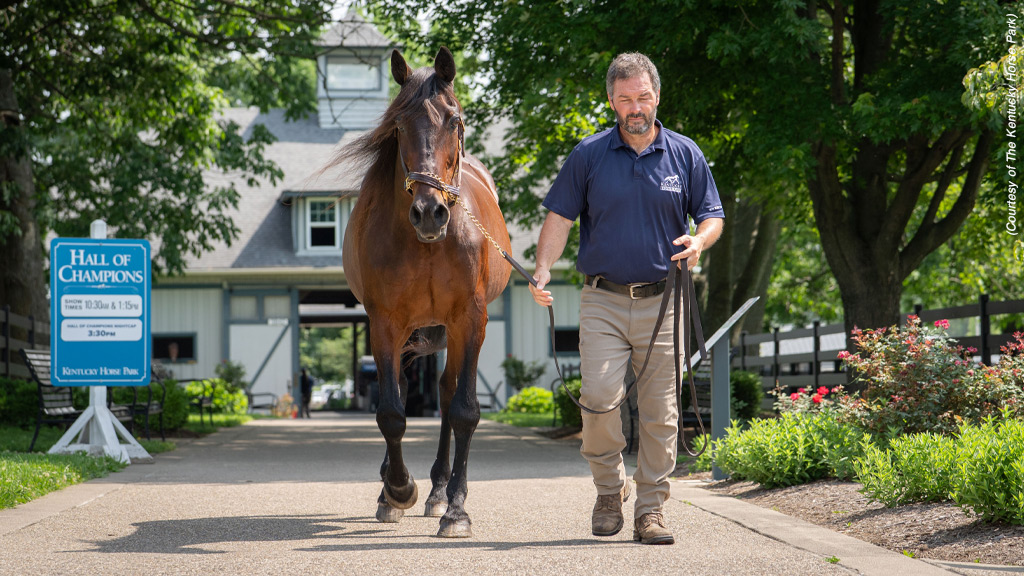
The son of Western Hanover-Fits Of Fun, and a resident of the Hall of Champions at Kentucky Horse Park for nearly a quarter of a century, died in March 2026, at the age of 32, while surrounded by an adoring staff that loved him dearly, including Hall of Champions Barn Manager Rob Willis and equine worker Jenny Leslie.
“Dreamer met tens of thousands of people, I can’t really put a number on it,” Willis said. “I’d tell people, ‘You’re petting Western Dreamer, that’s not petting your neighbour’s horse. This is Michael Jordan; this is Tom Brady. This is the top of the gene pool here.’” By Keith McCalmont.
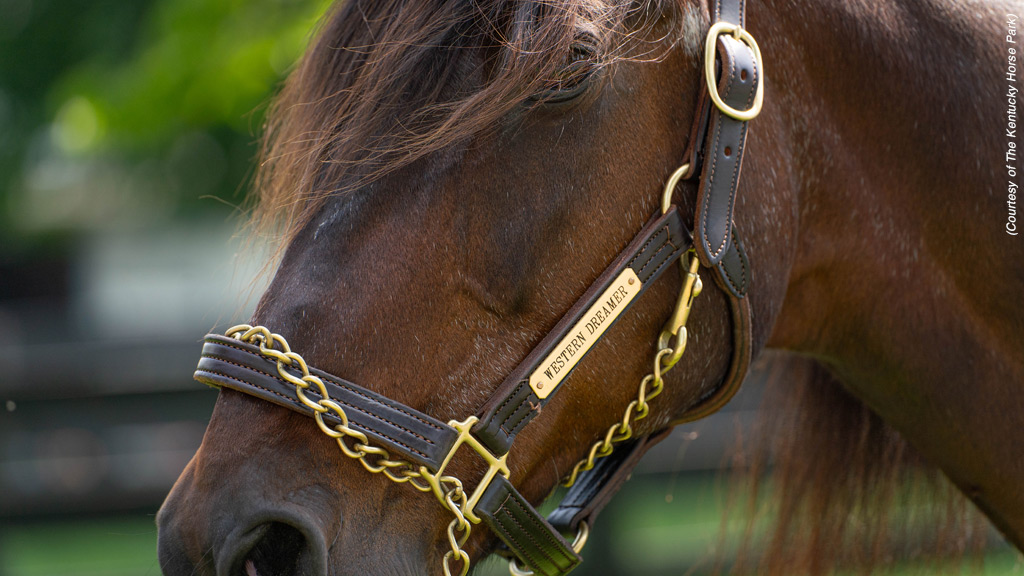
In April, it was announced that Western Dreamer would be inducted to the 50th Class of the Canadian Horse Racing Hall of Fame in the Veteran Horse category. It was Willis that got the ball rolling several years ago by writing to the Hall of Fame and outlining Dreamer’s accomplishments both on and off the track.
Western Dreamer encapsulated the key focal points of Kentucky Horse Park’s mission statement: ‘To celebrate the history of our relationship with the horse through education, exhibition, engagement, and competition.’
For Willis, Western Dreamer was not just a retired racehorse, he was a key member of the team.
“Dreamer was here for almost 25 years - longer than any other horse,” Willis said. “By far, he was the greatest testament to the Hall of Champions as far as being an ambassador. I nominated Western Dreamer to the Canadian Hall of Fame years ago. One of my points, other than his race record, was his accessibility to the fans. He had a stall guard up-front and Dreamer hung out over it all day. He was on the payroll. If three school buses full of kids pulled up, he’d literally give every single kid his full attention… they’d all get to interact with him.
“When people came here and met Dreamer, he was a very memorable horse for them,” Willis continued. “He wasn’t just a 32-year-old horse you could lead around. He was very full of life, very personable, and he interacted with everybody with enthusiasm. He wasn’t some pony you’d pet on the head - some happy trails horse - that wasn’t Dreamer.“
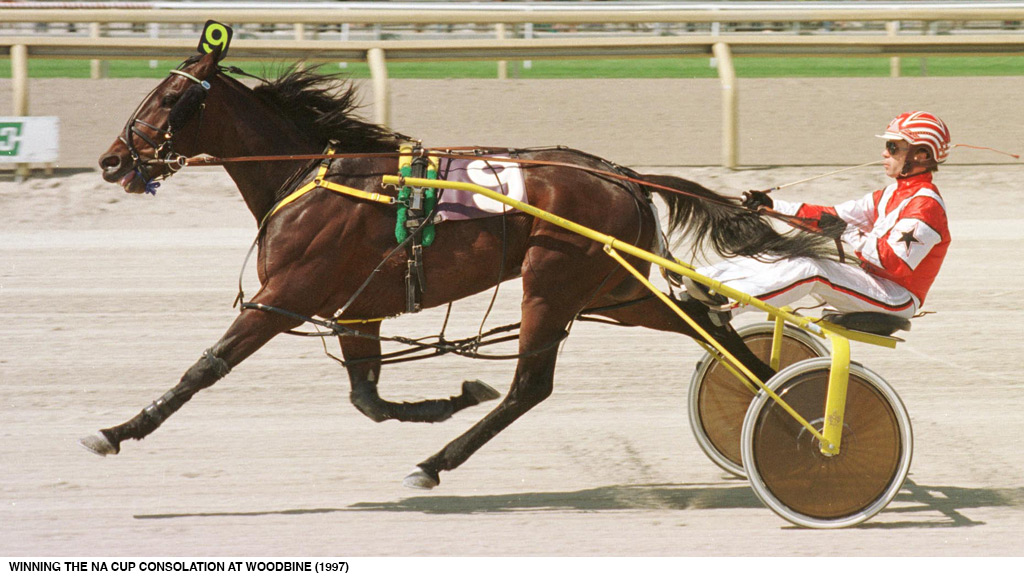
Of course, Western Dreamer had a lengthy list of accomplishments on-track as well, beginning his trek to Triple Crown glory with an odds-on, two length score on the engine in the Cane Pace [1:53.2] at Yonkers with Mike Lachance at the helm for trainer Bill Robinson and Canadian owners Dan, Pat & Matt Daly.
Despite the facile Cane Pace score, Western Dreamer went to post as the second choice in the wagering in the final two Triple Crown legs, due to the presence of Brett Pelling’s Dream Away, who won the $1 million Meadowlands Pace impressively earlier that summer with Western Dreamer settling for third.
In the Little Brown Jug, with a then record crowd of 56,129 on hand at the Delaware County Fairgrounds, Western Dreamer was again on the lead and romped to a five-length victory, in 1:51.1 - the fastest Jug final ever at the time - providing Lachance his fourth of an eventual shared record fifth Jug win. The unfortunate Dream Away went off stride early in the mile.
Western Dreamer finished third as the favourite in his Messenger elimination, won by Dream Away, after getting parked past the quarter from PP #7. In the final, he may not have been favoured in the betting, but he didn’t look at the toteboard while showing the way through splits of :28, 56.2 and 1:23.3, en route to a 4 ¾ length domination over the favored Dream Away in a final time of 1:51.3. In victory, he became the first Triple Crown winner since Ralph Hanover [1983], and there have been only two more since in Blissfull Hall [1999] and No Pan Intended [2003].
Western Dreamer’s successful Triple Crown bid also avenged the near miss by his sire, Western Hanover, who won both the Cane Pace and Messenger in a 1992 campaign that saw him denied by the narrowest of margins, by Fake Left, in the Jug.
While Western Dreamer failed to fire his best shot in the Breeders Crown, later that same year, when seventh to the victorious Village Jasper, he redeemed himself with a score in the Cleveland Classic in November, at Northfield Park, in what would be his final major victory at age three.
Western Dreamer was honoured as Canada’s Horse of the Year in 1997, and also named Pacer of the Year in the United States, for his incredible campaign, and although he would race for three more seasons, and earn another $421,645, a higher calling was awaiting him in Lexington.
Both Rob Willis and Jenny Leslie found their way to Kentucky Horse Park and into the heart of Western Dreamer the long way, following unique and varied career paths that eventually landed each of them in the heart of the bluegrass.
Willis, who turns 55 this year and also does social media work for The Red Mile, came to truly appreciate the Standardbred breed thanks to his duties at Kentucky Horse Park. While he attended the races in his youth, he became further exposed to the sport as a college student through a course at the Kentucky Horse Park that was part of his introduction to working hands-on in the world of horse racing.
“There was a small school here at the Horse Park called Kentucky Equine Institute,” Willis recalled. “I went to the school here in 1993. John Henry was here; Rambling Willie was here. Forego was the first horse I ever gave a bath to. It was six months for $600. I’d never touched a horse before that.”
Forego and John Henry were both Hall of Famers on the Thoroughbred side, while Rambling Willie, a U.S. Hall of Famer in his own right, was named Aged Pacer of the Year three successive years from 1975-77. Known as the ‘The Horse That God Loved’, Rambling Willie retired to Kentucky Horse Park in 1983, along with his goat, Billy.
The course made an impression on Willis, who soon found that his pursuit of a degree in accounting and business didn’t fulfill him in the same way as working outdoors with horses. He initially considered becoming a trainer, but then found his first calling, working on the breeding side of the Thoroughbred game at Brookdale Farm, and later at Respite Farm, before eventually landing at Kentucky Horse Park a decade ago.
“There were two Kentucky Derby winners, Go For Gin and Funny Cide, here at the time,” Willis said. “I thought that it would be a good place to go, to ply my trade with world-class horses, including Western Dreamer, Mr Muscleman and Won The West from the Standardbred side.
“From 1994 to 2017, I’d never been back,” Willis added of his return to Kentucky Horse Park. “Harness racing got me into horses, and then I switched over to the Thoroughbreds. The Derby winners got me here to the Horse Park, and when I got here it got me back into the harness racing… Dreamer, Mr Muscleman and Won The West were all great ambassadors. I take great pride in them.”
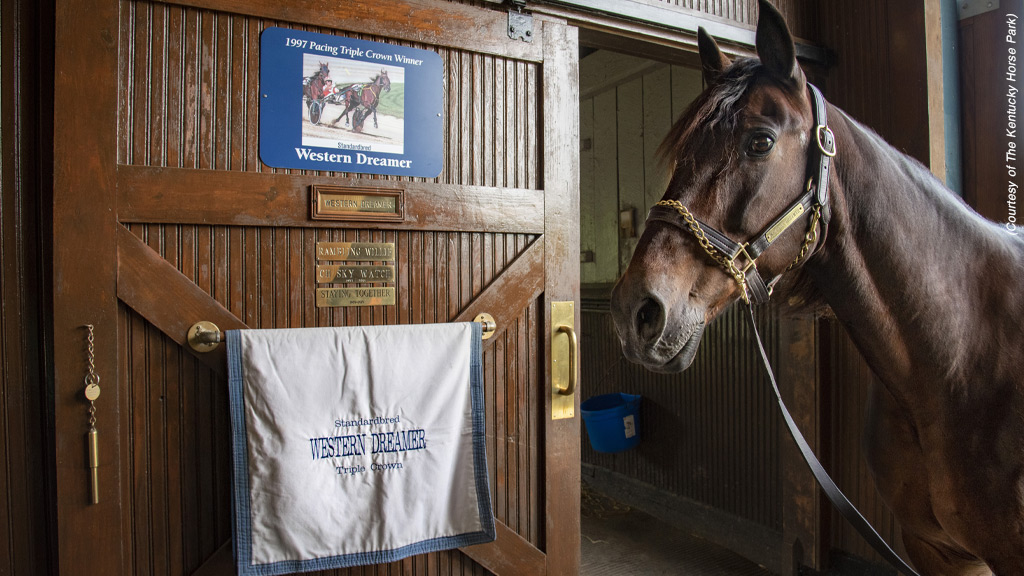
Willis assisted with 2016 Hambletonian winner Marion Maraduer’s arrival to the Park in 2022, joining his fellow Standardbreds, while sharing a shedrow with 2003 Kentucky Derby winner Funny Cide, who passed on in 2023.
“We’re one of the few barns to ever have a Hambletonian winner looking across at a Kentucky Derby winner,” Willis said, “but Dreamer outlooked them all. The others would look like grandpas. I’d pull Dreamer out and his coat was like he was hypoallergenic. He was dappled all the time. ‘Til the day he died, he looked like a thriving horse.”
Willis noted that Western Dreamer was uniquely suited to his role as an ambassador, with an incredible constitution and insatiable need to be the centre of attention.
“Mr Muscleman is a wonderful horse, very passive. You could land a helicopter on his back, and it wouldn’t bother him, but after 30 minutes of meeting people, he’d be like, ‘Let me go back over here, I’m an old man,’” Willis said. “Dreamer was not like that at all. He was half-human. I used to joke that he was on the payroll. When I took Dreamer over in his mid-20s, he would quite often go in every show, and still participate in the meet-and-greet after.”
While Willis had to manage the public facetime for some of the equine residents, he actually arranged ways for Dreamer to get more time with his adoring public.
“Dreamer would get mad if we started spending time with another horse. I’m not trying to Disney-fy it - I don’t have to make it up - that’s just how he was,” Willis said with a laugh. “When all the people were leaving, he’d be out front letting people pet him while he grazed. There was no bottom to that, he loved people and would do it all day.
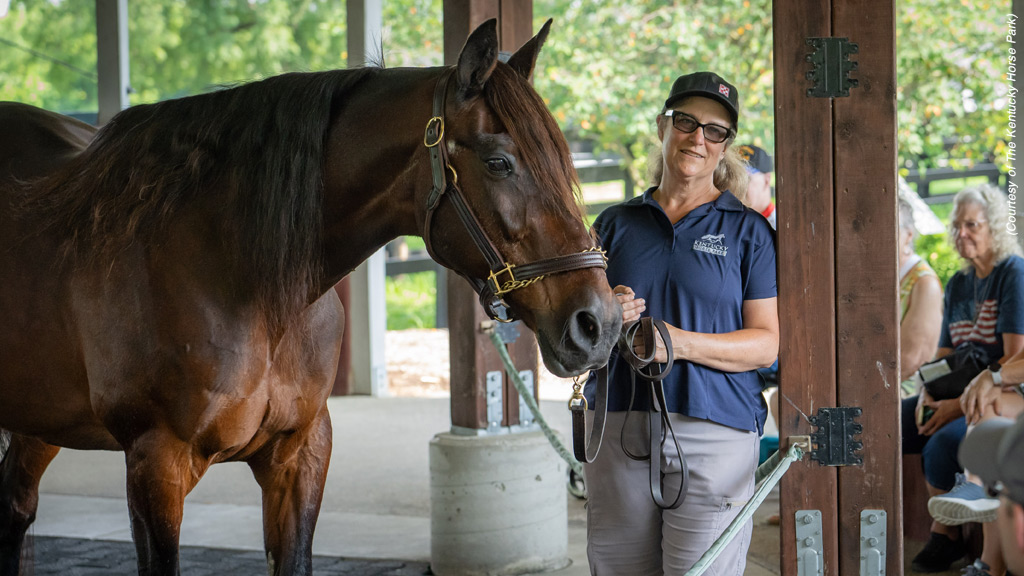
“He would adjust his demeanor if a kid with special needs came up too. Sometimes I’d actually have to walk away, it was that moving,” he added.
Ultimately, Willis believes that the way Western Dreamer thrived in his role not only served to bring new fans to the sport, but also added years to the Triple Crown winner’s life.
Dreamer was so loved, that Willis knew each and every visitor would leave with a new best friend, thanks to the bay’s rambunctious personality and attractive mane and forelock.
“I would often tease some of the kids who were just coming in by asking, ‘Have you got a favorite horse?’” shared Willis, with a laugh. “They’d say whoever, and I’d joke, ‘Well that’s about to change in 10 minutes.’ After they came back out, I’d ask again and they’d all say, ‘Western Dreamer!’”
Jenny Leslie, a Lexington native, retired from a significant career as a social worker for the U.S. Federal Government in 2013. She joined Kentucky Horse Park as a volunteer a year later, and was soon hired as a seasonal employee.
Like Willis, she’d had previous experience as a youth, visiting the Park.
“They opened in 1978, and my grandparents took me right afterwards. I’d go out there as well with my friends. One summer, when I was 15, I worked in their riding stable as a part-time job,” Leslie said.
“I retired early from the Federal Government, and I didn’t know what I was going to do… then I remembered that horses gave me a lot of joy when I was a kid, so I went to the Kentucky Horse Park. I’m in my 13th season now in the Hall of Champions.”
Leslie credits the residents of the Park with expanding her interest in harness racing.
“They had Cam Fella and Rambling Willie before I was here, and since I’ve been here we’ve had Staying Together and Dreamer, and we still have Mr Muscleman, Won The West - who is my favorite horse - and Marion Marauder,” Leslie said. “They were what got me interested in harness racing. I’d read Born to Trot as a little girl, so I knew the basics, but it was working at the Hall of Champions that got me truly interested in harness racing.”
Leslie’s second career is a busy one, beginning at 7:30am each day to clean, feed, groom and bathe the horses before the first of two pavilion shows, in which the horses are walked out to pose for the public while Kathy Vespaziani, the entertainment host and announcer for the park, introduces them.
“Kathy tells the story of each horse. We even show the highlights of their biggest races,” Leslie explained. “Later in the afternoon we do a nightcap, which is an informal thing. I turn horses out and take people by the fence, and I stand there and talk about the history of the sport and answer questions about horses. It’s a lot of fun. My job is half-groom and half-entertaining people.
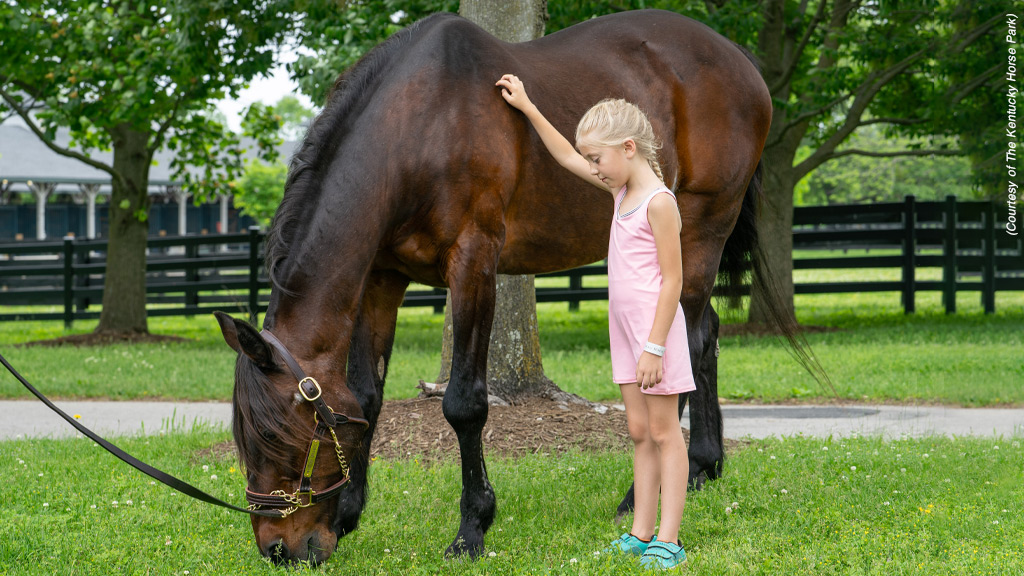
“This job gives me so much joy,” Leslie added. “I was good at my other job, and it was a good career - I enjoyed it and I worked hard at it - but this is the best thing that I’ve ever done.”
And if Leslie’s role is ‘half-entertainer’, she assures that Dreamer’s role was full-on entertainer.
“He loved to play with his Jolly Ball. He would chuck it out the window or out the stall door and we had to go get it for him,” Leslie said with a laugh. “He’d do it repeatedly. I think he liked us having to go fetch it. He was the best guy. If a branch fell off a tree in his paddock, he would pick it up and carry it around with him.
“We have a volunteer named Dave McMillan, and he would get Dreamer out and pose him with people for photos,” Leslie continued. “Dave would have the people stand by his shoulder and put their arm under his neck, and Dreamer would reach around with his neck and give them a hug. I don’t know how many thousands of pictures are out there of Dreamer giving someone a hug.”
And yet, for all his love for people, Dreamer didn’t care much for other animals.
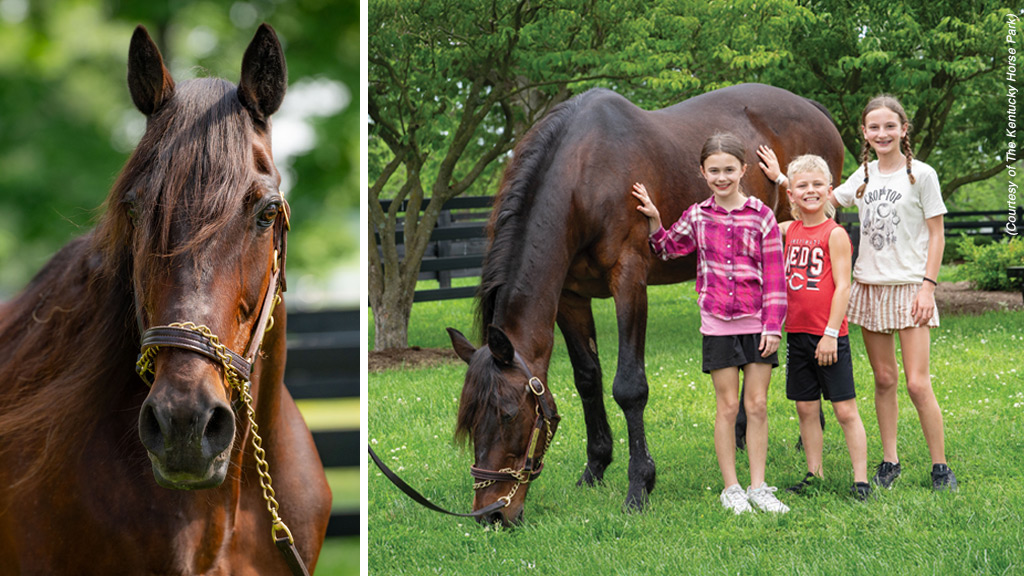
“We tried putting him with another horse in the paddock, but he wouldn’t ever stop posturing and he would squeal,” Leslie said. “So we kept him in his own paddock and he had a horse across the fence from him - he was cool with that. He just didn’t like them to get too close.
“He didn’t like dogs or cats either,” she added. “When Rambling Willie passed away they tried to put his goat with Dreamer, but he wasn’t having it. He would bully the goat, so they had to build the goat a house of his own.”
And while Dreamer never really warmed up to Mr Muscleman or Won The West, he had nothing but patience for the late Staying Together, known to all onsite as ‘Stanley’.
“He loved Staying Together,” Leslie said of the 1993 Horse of the Year, who had one eye and was blind for the last 10-15 years of his life. “Dreamer would be in a stall and Stanley would be in Dreamer’s paddock during the day. If we walked Stanley where Dreamer couldn’t see him, Dreamer would yell and call for him until we brought him back. They’d stay in stalls next to each other or just down the way as well.”
Dreamer’s antics, which included the Triple Crown winner drooling down Leslie’s neck at first introduction, were plentiful. Leslie echoes the testimony of Willis regarding Dreamer’s never-ending appetite for attention.
“Dreamer never wanted to be by himself. A lot of them, we make sure they have days off. Some of them don’t interact as well with people as others, but with Dreamer, if he wasn’t in the show, he would get mad and bang on his stall door to protest. Sometimes we’d just add him into the show even when we hadn’t planned to - just to make him happy.
“He wanted attention all the time. It wasn’t that he was just sweet either. A lot of horses are sweet and let you pet them - he was full of sass and he liked to play,” she added. “We’ll never have another one quite like him.”
Leslie has seen first-hand the impact of Western Dreamer’s ability to promote the sport.
“When The Red Mile is on, I’ll tell people they’re racing Sunday night, and a lot of those people I’d see later that night at the track. Dreamer was a part of that. He taught a lot of people about harness racing and what it was,” she said. “I’m so excited that he’s a Hall of Famer now, too. I love that for him.”
Such was Western Dreamer’s popularity, that one visitor even decided to include the Crown Champion in a marriage proposal.
“He had a cooler custom-stitched to say, ‘Will you marry me?’ on the side. They came into the barn and the boss said to the woman [as part of the plan], ‘We’re doing a photo shoot for the Horse Park, would you like to be a part of it?’” recalled Leslie. “So, she’s ooh-ing and ahh-ing over Dreamer and how beautiful he is… and then they turned him, so the cooler faced out, and she was so caught up with Dreamer, she didn’t even notice the proposal. But she did eventually say yes!”
The ever-present Western Dreamer passed away in March, at the age of 32, bringing an end to an incredible life as both a racehorse and ambassador. The impact of his passing resonated across Kentucky Horse Park.
“Dreamer meant a lot to the staff and volunteers. He was truly, truly loved,” Willis said. “Everyone checked on him - not just people from my barn, but people on the team from HR, to billing, to maintenance. He had a lot of people that cared about him.”
The stoic Willis admits that he became more attached to Dreamer than to any other horse in his career.
“I love horses, but back when I worked as a yearling manager, it was ‘foal, yearling, gone; foal, yearling, gone.’ I never was with a horse for a long period of time - the mares and stallions were with a different division,” he shared. “When I started working with Dreamer, it was much more of a relationship. I became much more attached to Dreamer. I was his caretaker through [10 years of] his retirement as an ambassador.”
An arthritic knee was an ongoing complication for Western Dreamer that Willis and his team dealt with professionally in his later years.
“Rob Willis has taught me a lot about taking care of older horses, and he really taught me a lot about how to help Dreamer live his best life,” Leslie said.
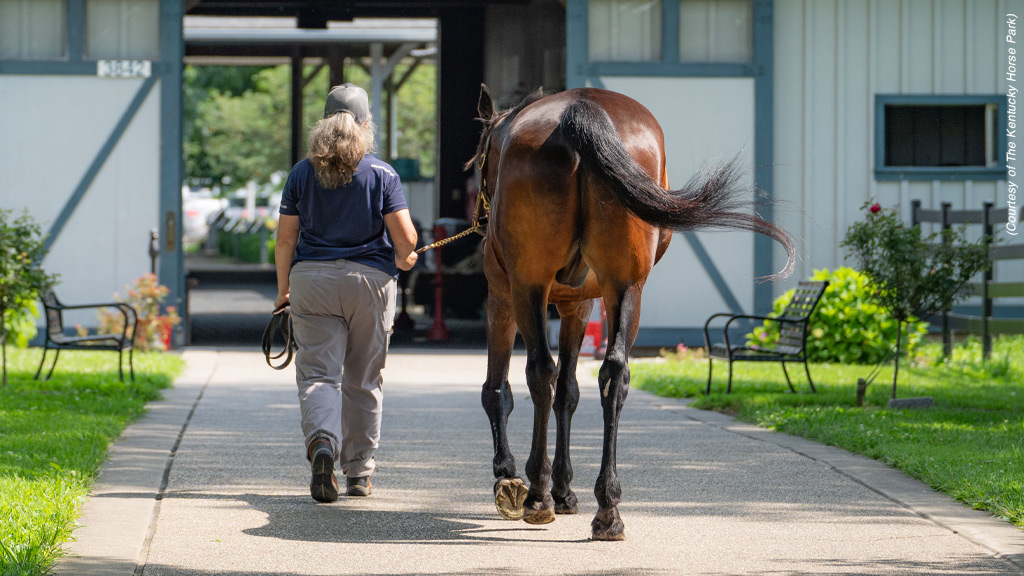
Leslie said that losing Dreamer definitely hurt, but she’s finding comfort in recalling the joy he brought to all he encountered.
“I always tell people that if you never experience that pain of losing them, that means you’d never have experienced the joy of loving them,” Leslie said. “He had such a good, long life, and a good death, surrounded by the people that loved him, on a sunny day with a bucket of treats.
“There used to be a man that worked in our barn named Gene Carter, and he worked at the Park until he died at 93,” Leslie continued. “He used to gallop racehorses and break yearlings, and he was the last person alive to sit on Man O’ War. He was a legend at the Park, and he passed away a few years ago. Right before we let Dreamer go, I told him that Gene would be his groom now, and that he’d be waiting for him at the finish line. That made me feel a lot better.”
Willis noted that visitors are still coming by the barn and sharing memories of having met Western Dreamer.
“I’ll keep his sign in the barn, prominently for people that maybe saw him last spring but won’t see him this summer,” Willis said. “People come here and see him for 20-30 minutes, and then don’t come back for two years, but they remember him.”
A special stone will mark the final resting place of Western Dreamer, out front of the Hall of Champions - a prominent position suitable to the demanding nature of the great pacer.
“His legacy will live on. He’s still out front here, and we’ll continue to tell his story,” Willis said. “What’s sad to me isn’t that he’s gone or that I miss him, it’s sad that there’s people that didn’t get to meet him. I know Dreamer had a good life - Triple Crown winner, Hall of Famer, met tens of thousands of people. I miss him. I loved Dreamer. He lived a long life, and I made him available to as many people as I could.”
This feature originally appeared in the June issue of TROT Magazine. Subscribe to TROT today by clicking the banner below.