
Majestic Son: Surpassing All Expectations


A moderately-priced, Ontario-sired yearling with some pacing blood in his pedigree, when Mark Steacy and his father picked Majestic Son out as a yearling they weren’t exactly thinking ‘Horse of the Year’ candidate. After their Angus Hall colt defeated the U.S. Triple Crown winner, Glidemaster, in the Goodtimes, Canadian Trotting Classic and Breeders Crown however, that’s exactly what they ended up with following the 2006 racing season. By John Rallis.
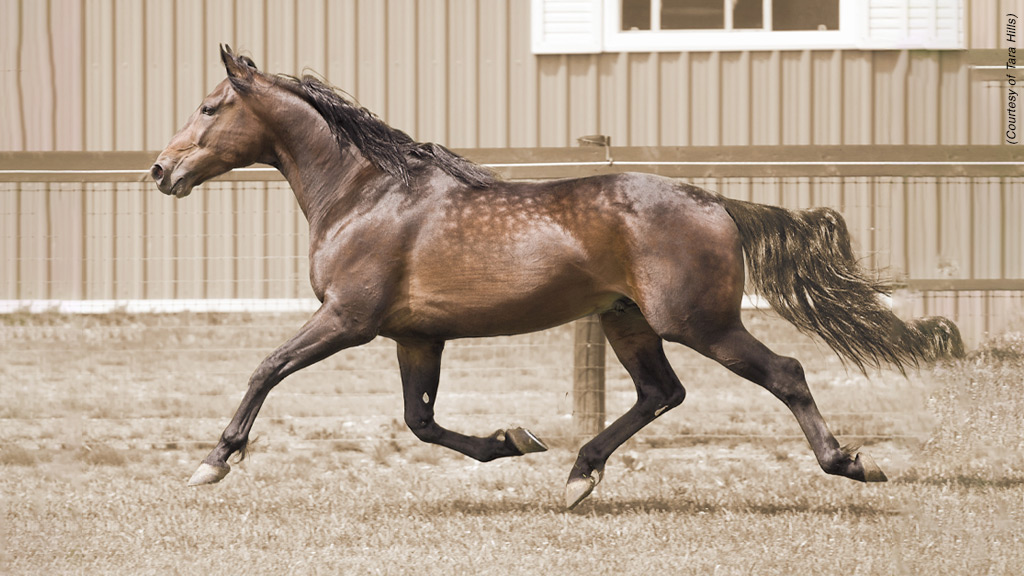
There are some horses that arrive with enormous expectations, and then there are the ones that force people to believe in them after the fact. Majestic Son belonged firmly in the second category.
Purchased for the modest price of $33,000, and carrying more question marks than hype, he steadily transformed from an overlooked yearling into one of the most accomplished trotters of his generation. What started as a pleasant surprise eventually became a Hall of Fame career, as Majestic Son evolved into one of the greatest trotters Canada has ever produced.
“My father and I co-owned Majestic Son when we purchased him at the sale,” his former trainer, Mark Steacy, recalled. “We owned him throughout his two-year-old campaign and then we sold our share to Peter Heffering before his three-year-old season.”
At first glance, there was plenty to like about the colt physically, even if his pedigree left some uncertainty.
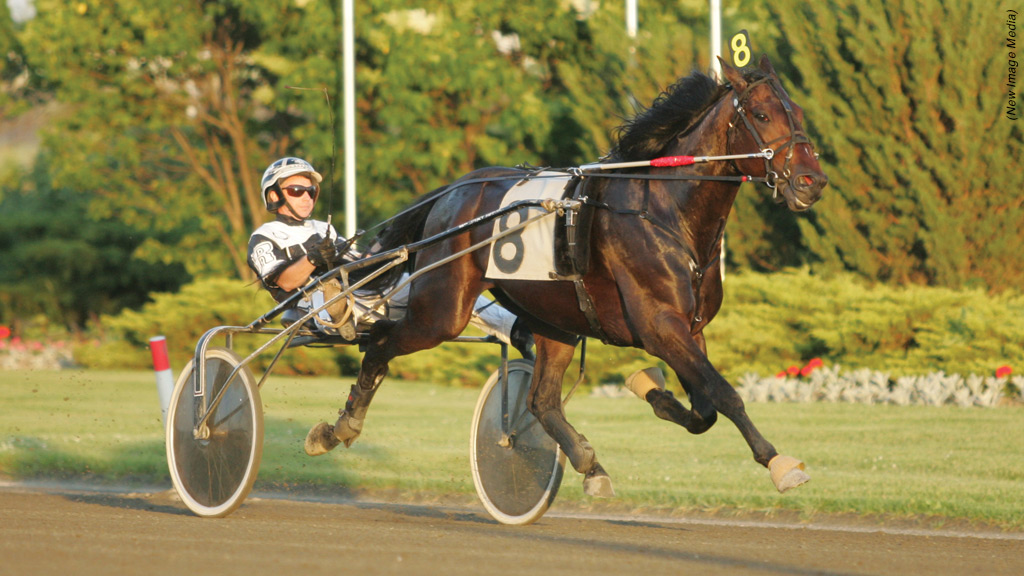
“He was a really correct colt… Actually, he was a ridgling at the time, and truthfully, that didn’t bother me too much. I thought he checked all the boxes at the sale, and to top it all off, he sold for a very reasonable price.
“He had kind of funny breeding,” said Steacy. “There was some pacing blood on the mother’s side [Celtic Contessa], but there were also a couple of nice trotting racehorses in her family too. There was speed in the family, but it was a bit tricky in that regard.”
And even after the colt trained down impressively, Steacy remained realistic.
“He trained down nicely, but you never really know you’ve got a great horse until you get racing them… it didn’t take long for the signs to emerge though,” stated Mark.
Majestic Son’s first career start came in an Ontario Sires Stakes event at Georgian Downs, and while the official charted line hardly screamed ‘future superstar,’ Steacy drove home from Barrie that night convinced he had something special.
“I drove him myself that night, and the guy in front of me, his whip accidentally hit my horse in the head, causing us to make a break at the three-quarter pole. When he got trotting again, he gained like ten or fifteen lengths after that… I remember coming off the track and turning to my son, Shawn, who was grooming for me at the time, and saying, ‘You know what? I think this is a damn good horse.’”
The next few starts only reinforced that belief. After a qualifier, Majestic Son returned in another OSS event at Grand River Raceway, only this time, with a much better result.
“I won with him that day by open lengths,” Mark recalled. “Paul MacDonell happened to be there and I asked him if he wanted to sit behind him in the final the next week because I thought he was a really nice horse - he obliged.”
MacDonell captured the $130,000 final with the colt before reinsman Rick Zeron took over the controls. With Zeron in the bike, Majestic Son captured a division of the Champlain Stakes before running into some breaking issues, and then closing out his season with a win in the $300,000 OSS Super Final. His rookie season saw him win five times in 13 starts while amassing $527,886 in purses.
By September of that year (2005) people in Canada were speaking highly of the talented trotter, but much of the spotlight at the time belonged to another highly touted rookie who had also launched his career north of the border: Blair Burgess’ Glidemaster.
With only two starts under his belt prior to their Champlain Stakes match-up, Glidemaster had already generated an enormous amount of buzz - and for good reason. After two open-length victories from outside posts - one with his trainer in the bike - the talent was obvious.
While Majestic Son’s resume was impressive to that point as well, many believed the Blair Burgess trainee was a notch above - until after the two actually squared off at least.
“Glidemaster was a really highly-touted horse, even at two, and he displayed a lot of ability,” Steacy said. “Despite our early success, we still weren’t viewed as the horse to beat in the Champlain, but after that race, people started looking at him differently.”
Majestic Son went off as the 4/1 second choice in the $106,965 Champlain Stakes, and proceeded to defeat Glidemaster - the 2/5 favourite - convincingly, delivering the type of performance that immediately changed perceptions.
Defeating Glidemaster, a horse many thought could be the best in the division, only strengthened the belief Steacy already had in his colt, and validated what he had suspected from those early efforts. It also marked the beginning of what would become, at the time, one of the sport’s most talked about rivalries.
The rematch, however, would have to wait until their sophomore seasons; and when the two met again at three, the results didn’t change.
Unfortunately for Steacy, he never had the opportunity to showcase Majestic Son in the sport’s biggest trotting event - the Hambletonian - but his colt made up for that time-and-time-again regardless.
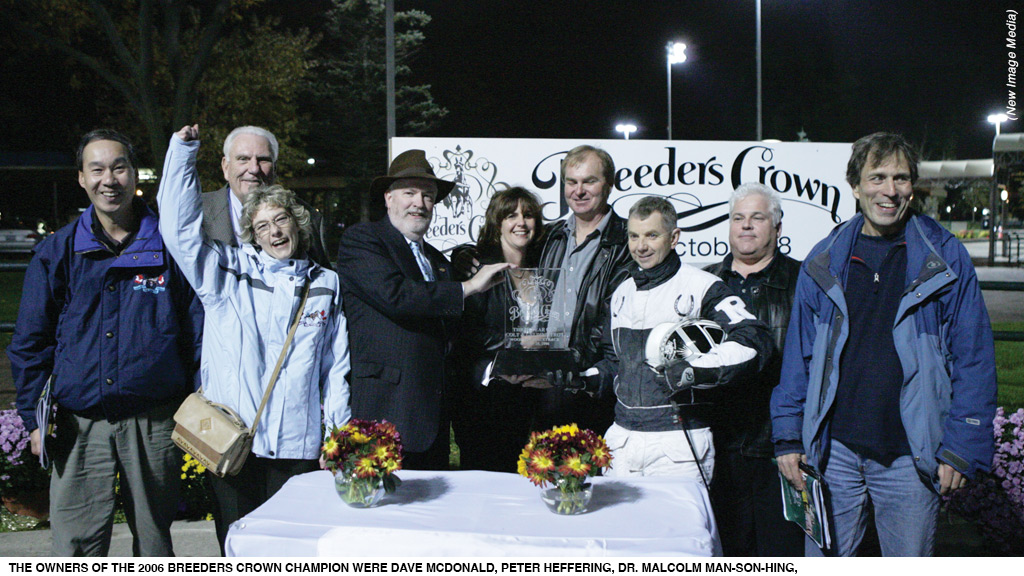
“I didn’t have a lot of money at the time, so when we bought him for what we did, I never dreamed he’d be a Hambletonian-caliber horse, or even one that would be good enough for the Breeders Crown,” Steacy admitted. “Even now, it’s hard not to wonder what could’ve happened had we paid him into the Hambletonian.”
It’s a fair question to ask, as Glidemaster went on to capture the $1 million Hambletonian in 2006, only fueling speculation about what Majestic Son might have accomplished had he been eligible.
“I’m not saying we would’ve won the Hambletonian, nor am I saying Glidemaster wouldn’t have won it anyway,” Steacy said. “But I think it’s fair to believe we would’ve had a big opportunity to win that race, especially considering how we fared against him whenever we hooked up.”
The claim was more than reasonable considering Majestic Son held the edge practically every time the two competed against one another. Despite Glidemaster putting together a sensational sophomore campaign, capturing the Trotting Triple Crown, and being named 2006 U.S. Horse of the Year, the son Ontario-sired son of Angus Hall-Celtic Contessa simply seemed to have his number.
“I never really looked at it at the time as a rivalry, if I’m being honest, but there definitely was added motivation,” Steacy admitted. “There were a couple horses getting a lot of publicity. Chocolatier was probably the highest touted three-year-old [in North America] coming into that season, so that’s the one that provided me with the most concern, but Glidemaster was right there as well… mine just flew under the radar.”
Despite his record, Majestic Son didn’t command the same respect as his rivals in American racing circles, largely because he had never raced in the United States, but with every major stakes showdown against Glidemaster, opinions slowly began changing.
Every meeting between Majestic Son and Glidemaster carried extra weight. Many Canadian fans rallied behind their homegrown star, while most American prognosticators still leaned toward Glidemaster. The debate became unavoidable: Who was truly the better horse?
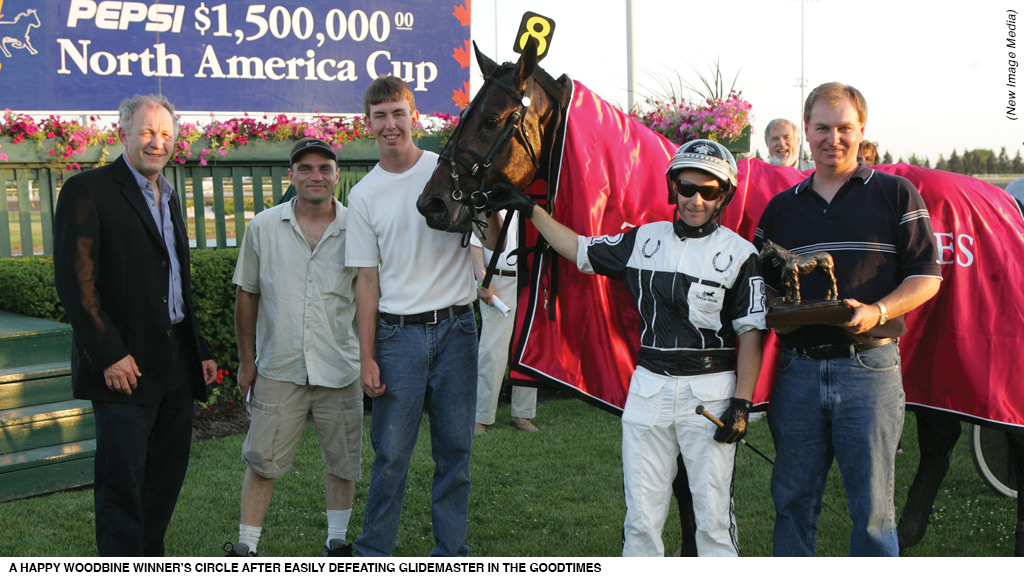
Their only early-season match-up at age three came in the Goodtimes at Mohawk, where Majestic Son once again soundly defeated his arch-rival, runner-up Glidemaster, by 3 ¼ lengths.
For Hall of Fame driver Trevor Ritchie, who piloted Majestic Son throughout his three-year-old campaign, the answer was simple.
“Funny enough, I drove Glidemaster as a two-year-old, so there was a little bit of an incentive to beat him afterwards, which I was fortunate to do,” Ritchie said with a smile. “Not once when I raced against him [Glidemaster] with Majestic Son, did he win a race.”
Ritchie believed the media attention surrounding the rivalry was justified because the two represented the very top of the division.
“I remember hearing the chatter with all the rivalry talk, and I understood it,” he said. “But I did always think we were better.”
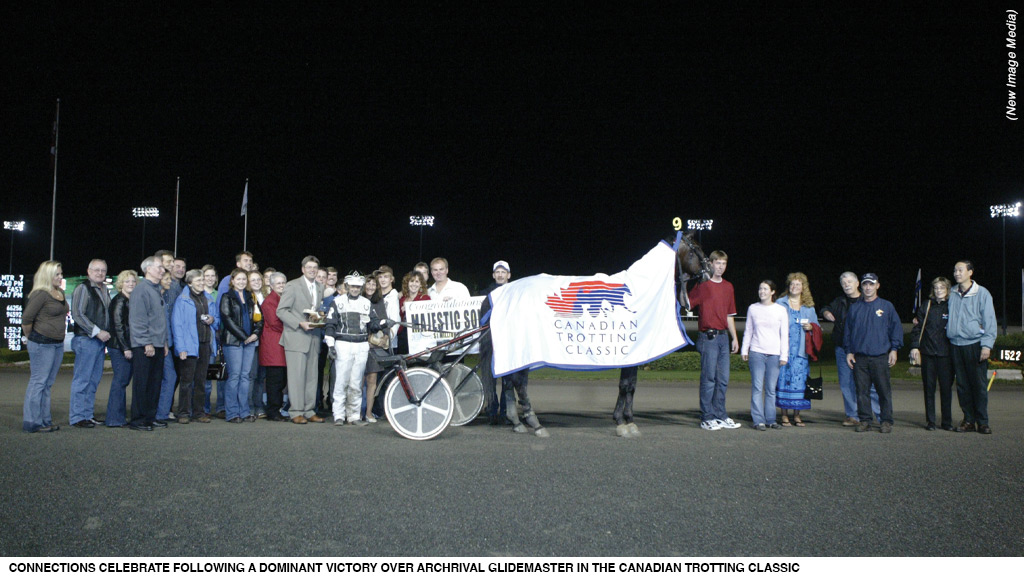
The defining chapter of that rivalry came in the $1,000,000 Canadian Trotting Classic at Mohawk in mid-September. Majestic Son had only been beaten once since his Goodtimes triumph, and Glidemaster had won the Hambo in a stakes record 1:51.1.
Majestic Son drew the dreaded nine-hole, leaving many wondering whether his chances had disappeared before the wings of the gate even folded.
“When it came to the Canadian Trotting Classic, we drew the nine-hole,” Steacy recalled. “My father was with me, and we were with Trevor, at the sale at Mohawk, when the draw came out. He turned to Trevor and said, ‘Do you think we can even get a cheque?’”
Ritchie’s response instantly became part of Majestic Son lore.
“Trevor said, ‘We aren’t just getting a cheque, we’re going to win the damn thing.’”
That confidence stemmed from how highly Ritchie thought of the horse.
“Outside draw or not, I had all the confidence in him in the world that night,” Ritchie said. “Obviously the draw wasn’t ideal, but when you have that much confidence in a horse, it doesn’t matter where you start from.”
On one of the biggest nights in Canadian harness racing, Majestic Son delivered yet another unforgettable performance, winning by 6 ¾ lengths, at odds of 5/1, and capturing the Canadian Trotting Classic in emphatic fashion.
“The only million dollar race that I’ve won was the Canadian Trotting Classic,” Steacy said. “I had to pinch myself as soon as he crossed the wire to make sure it was true.”
The victory only intensified the Majestic Son-Glidemaster debate.
“Not too many people said much good about him leading up to the Canadian Trotting Classic and the Breeders Crown,” Steacy explained. “He didn’t get that respect going in, but he certainly got that respect after those events, especially after beating Glidemaster in each.”
If the Canadian Trotting Classic proved Majestic Son belonged among the best, the Breeders Crown confirmed it was no fluke.
For Ritchie, that late October race at Woodbine remains unforgettable.
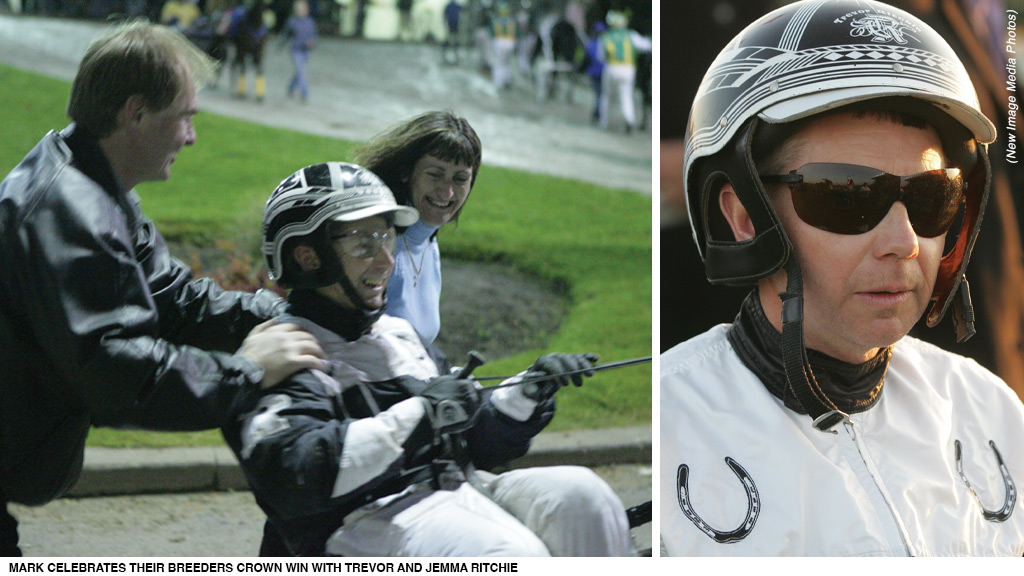
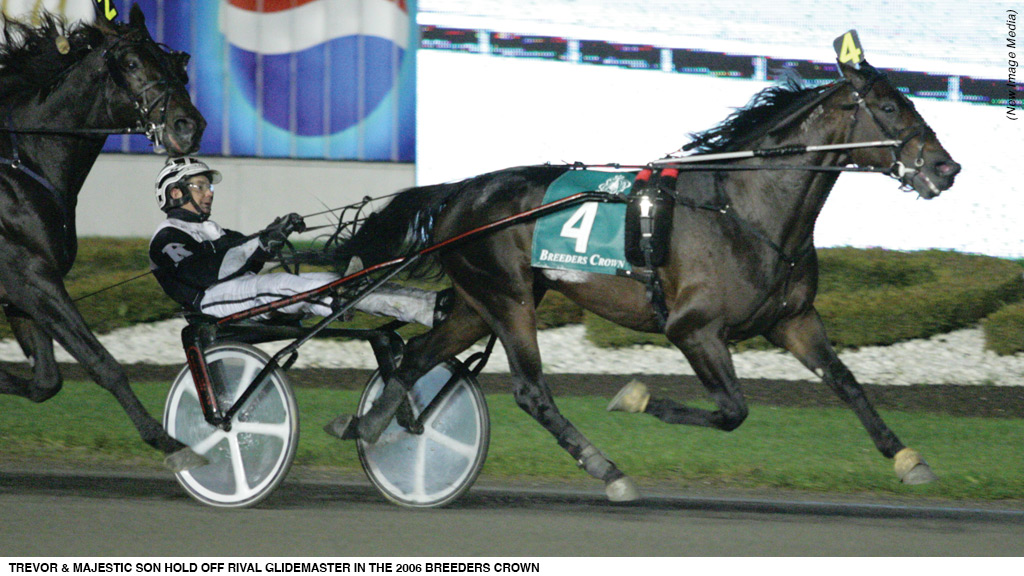
“The race that stands out to me the most was the Breeders Crown victory at three,” he said. “I moved him multiple times, and Glidemaster was right at my throat at the head of the lane. He might’ve been half-a-head ahead of me actually, but then we marched through the lane and prevailed.”
“That’s how much confidence I had in him,” Ritchie added. “I could make a few moves with him and it didn’t matter. He was an incredible horse. I was honoured when they asked me to sit behind him.”
Steacy often described Majestic Son’s victories with one word: authoritative.
“When Majestic Son won, he didn’t just beat them, he won convincingly,” Steacy said. “The only time he would get beat was when he made a mistake and beat himself.”
There were even nights when the horse overcame physical issues that would have sidelined many others. Steacy recalled one memorable OSS Gold event at Flamboro Downs where Majestic Son looked almost too sore to compete.
“Shawn had put a foot packing in his foot and it seeped up and blistered the back of his heels,” Steacy explained. “He warmed up really lame that day. When I warmed him up, I thought, ‘I don’t know if I’ll be able to race this guy today.’”
Steacy instructed Ritchie to score him down during the post parade and scratch him if the horse didn’t feel right.
“Trevor scored him down, and he stayed on the trot, so we raced him. Turns out he actually set the track record [1:55] that day. It was remarkable.”
Even late in his three-year-old campaign, while battling physical issues, Majestic Son continued producing elite performances.
“He was a little lame at the end of the year when we went to the Breeders Crown,” Steacy said. “He got a little iffy-gaited at the end of the mile, but he showed a lot of courage that night as well.”
His dominance throughout the season ultimately earned him O’Brien Canadian Horse of the Year honours in 2006.
“It was a huge honour,” Steacy said. “That was the first time I had trained a Horse of the Year, so it was undoubtedly a huge thrill for all of us.”
Following his Horse of the Year campaign, Majestic Son returned at age four and initially looked even better than before.
“He came back so good as a four-year-old, and he showed so much talent,” Steacy said. “I thought to myself, ‘Wow, he’s come back so damn good.’”
But warning signs soon appeared.
“When we raced him in the Frank Ryan at Rideau, he almost ran leaving… He still won, but I found it a little strange.”
In his next start, the $300,000 Nat Ray at The Meadowlands, which marked his first appearance in the United States, Majestic Son delivered a disappointing effort, leaving Steacy searching for answers.
“I couldn’t figure out what was wrong, so [after one more start] I took him to Terry Ruch… we found he had a fractured tibia bone. We retired him right after that.”
“It’s amazing that he still won the Frank Ryan, even with a fracture,” Steacy added. “But it obviously affected him in his lone U.S. appearance.”
Although the injury prematurely ended his racing career, Majestic Son had already accomplished more than enough to secure his legacy.
Following a career that earned him $1,993,157, Majestic Son entered stallion duty at Tara Hills Stud in Port Perry, Ontario.
“I think we made a couple of small mistakes, and we probably stood him at too high of a fee to start,” Steacy admitted. “Not to mention we were going head-to-head with Kadabra at the time, who was a pretty popular stud.”
Eventually, Majestic Son relocated permanently to Australia, where, as previously featured in TROT, he’s become a very successful sire.
“He became the top sire [Downunder] for a few years, so it was a great move for him to go over there,” Mark added. “I’m very happy to see him have success there as a stallion.”
Still today, Steacy places Majestic Son above every horse he has ever trained.
“I would say that he’s both the best trotter I’ve ever trained, and the best horse that I’ve ever trained.”
Majestic Son wasn’t necessarily a horse that people expected to become the star that he was, nor was he always the heavily promoted superstar who carried all the headlines entering the biggest races. Instead, he became the horse who forced everyone to change their opinion over time - and Canadian fans especially, embraced every second of it.
“He did have a lot of respect from Canadians,” Steacy said. “A lot of people got a chance to watch him race, so they knew exactly how good he was. As did we.”
That admiration followed him long after retirement.
“After he retired, we had a Majestic Son Open House [at our farm in Lansdowne, Ontario] because he was kind of a hero among everybody down that way,” Steacy recalled. “We attracted 1,000 people that day to come see him and get pictures taken with him.”
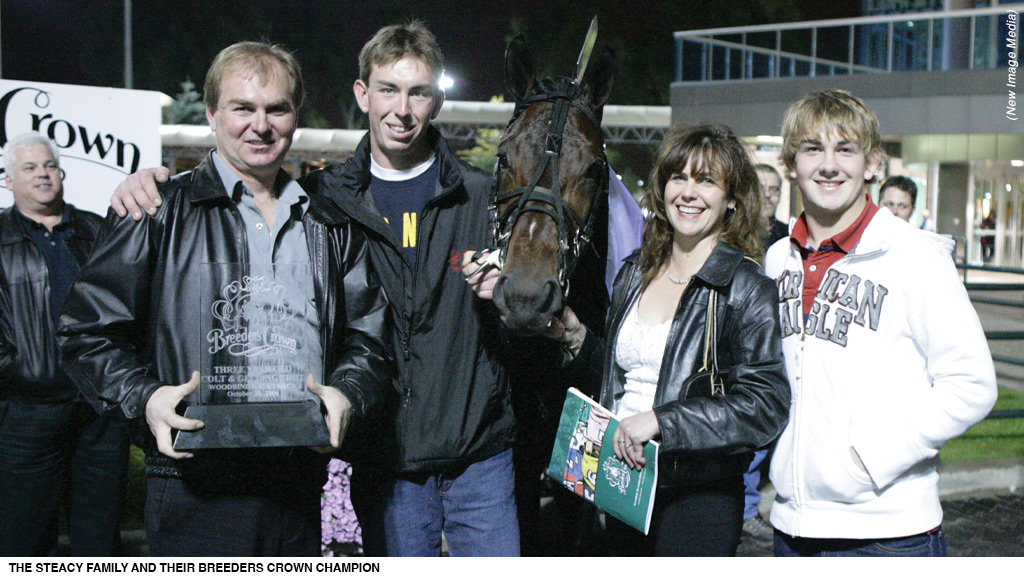
For Steacy, though, the memories attached to Majestic Son extend far beyond trophies, photos and accolades - that’s because of what the horse represented to his family.
“My dad passed away two years ago. I started in this business with him. He was my hero, he was right there, and we worked in unison when we picked this horse out at the yearling sale. I wish he was here today to see the horse get rewarded like this.”
Majestic Son earned his status by showing up in the biggest moments, taking on the best horses of his era, and continually proving people wrong. He ultimately rose to the highest level of the sport, and earned his place into the Hall of Fame… and along the way, he made the Steacy family very proud.
This feature originally appeared in the June issue of TROT Magazine. Subscribe to TROT today by clicking the banner below.