
SC Rewind: Remembering Bob Farrington, Part 1


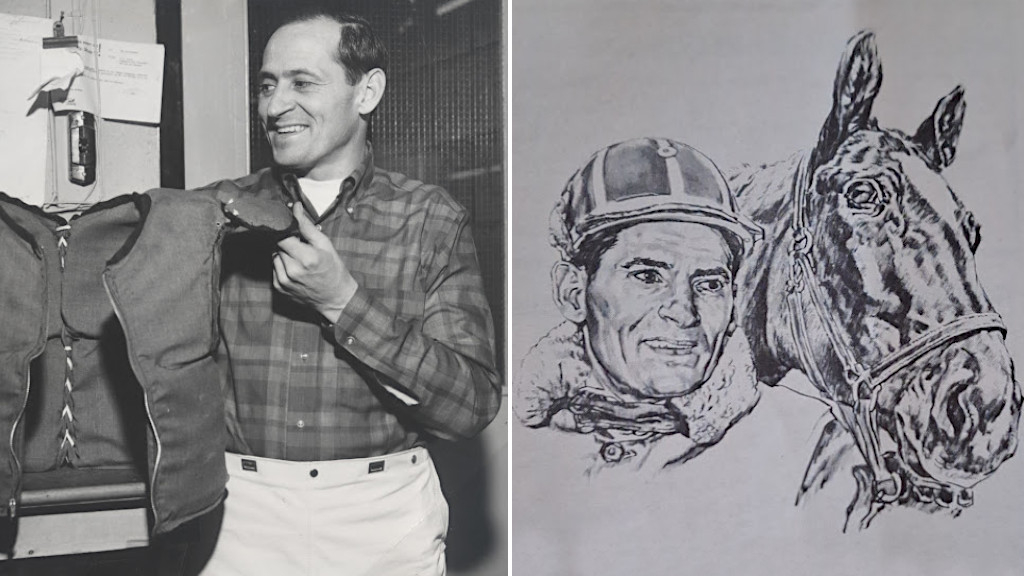
In this week’s issue of Rewind, Robert Smith recalls the long and highly successful career of the late, great, all-around horseman Robert “Bob” Farrington. This topic will appear in two parts, with the second covered in an upcoming Rewind.
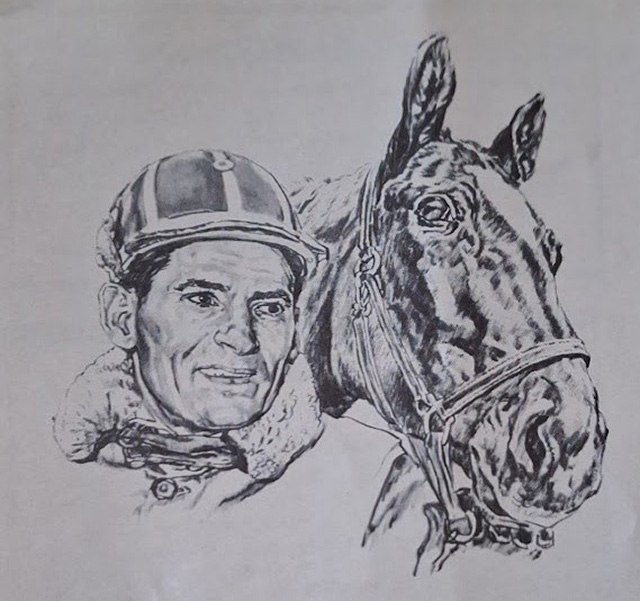
Bob Farrington caricature (Courtesy of Harness Racing Institute of Chicago)
When Bob Farrington decided to change career paths back in the 1950s and become a full-time harness horseman, he was faced with a rather difficult decision. His then-current occupation (see trivia question at page bottom), which he enjoyed, was providing him with a comfortable living. He was earning $3.50 per hour, and with frequent overtime on top of that, he was relatively satisfied.
In time, however, he did decide that he wanted to devote his full attention to owning, training, and driving harness horses, which he eventually did in 1955. It was a calling he felt deeply. In later years, he told a sports writer, “I always liked to watch the fair races as a youngster in Ohio. In 1954, I got my own horse and trained him after work. We raced on the weekends but never did anything.
“The following year I had an old mare named Grand Martha and started winning races at the Lebanon, Ohio track. The purses were low, but her continually good races led me to think about trying the sport on a full-time basis.”
Several months later, after quitting his job, he put in his first season. At the end of 1955, he had 14 wins and purse earnings of $3,000 to start his résumé.
Bob drove in his first lifetime race at the fair meeting held in Piketon, Ohio, not far from his home area. He gained his first-ever win behind Grand Martha at Hilliards Raceway in 1955.
In 1956, he increased his win total to 37, and his stable earnings rose to $13,155. The following year, he was beginning to show a nice profit while competing on the Ohio fair circuit as well as at smaller pari-mutuel tracks. His newfound calling was soon progressing at a favourable pace. While he had at times contemplated heading back to his former occupation, he always convinced himself to stick with it.
In 1958, Bob made a huge decision as he elected to try his hand at the major tracks. He became an immediate success at the Chicago tracks as well as Brandywine in Delaware, and he also enjoyed a short stay on the Maryland circuit. As he continued his rapid progress, by 1959 he finished third nationally by virtue of his 129 wins. Along with the increase in wins came a boost in purse money to $75,609.
His rise in recognition was soon catching on across the sport. His in-the-money percentage quickly rose to the .300 level and stayed there. His great driving talent was only part of the success story. He had quickly and surely organized a family business operation that could easily be the envy of many long-established stables.
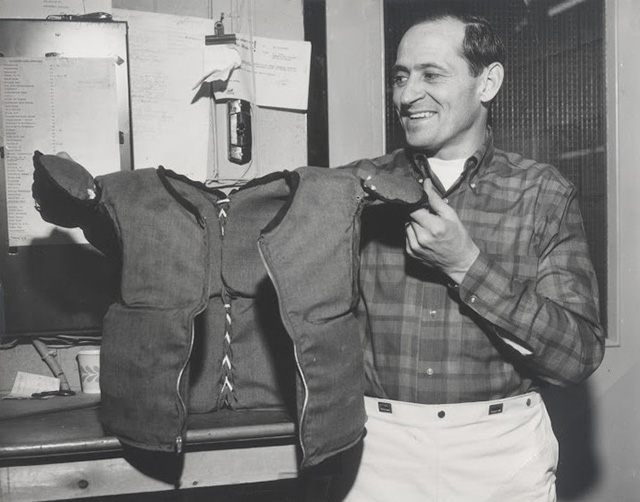
When this new “Protecto Vest” was introduced to harness racing back in the 1960s, the Protecto Company displayed this great photo of Bob Farrington as a user.
By the late 1960s, his stable included over 140 horses in all. His plan was to race them in two strings and keep a third at his Richwood, Ohio, farm. One division he headed up personally, racing either in the Chicago area, California, or New York. The second was handled by one of his brothers, usually Brad, also an accomplished driver. They frequently raced in the Ohio and Michigan areas.
In an interview at about this time, he stated, “Having my brother Dick and John Miritello, a former New York City policeman, with me most of the time to help with training has made things a lot easier. I have to know what’s going on all over the country in order to set up races for some of the better horses so we can rest them at the right times.”
The third contingent was based at the farm, with his dad “Louie” in charge. His task was to train and ready horses after layoffs or for other reasons. Between the three bases, the stock was shuffled back and forth. Most of the horses in this vast array came about via the claiming route, while some were purchased.
Farrington’s approach was somewhat novel for the times. He concentrated on claiming horses and was not concerned with losing them.
In the beginning, many of the Farrington horses were of the “cheaper” class, which was his plan, but that soon changed. Once he teamed up with a great owner named Lloyd Arnold, a wealthy cattleman and livestock auctioneer from Geneseo, Ill., he started to concentrate more on “class” performers. In late 1965, they purchased Bosco Rosco, a speedy pacing stallion, for $50,000.
After that initial large purchase came several more in the five-figure category. They included Dancing David ($55,000), Easy Prom ($50,000), and Meteor II, a French-bred trotter ($15,000). Also entering he and his partner’s ownership was Kalam’s Peak, secured on a three-year lease from New Zealand.
While never one to become too sentimental or attached to any of his horses, he fondly remembered one that held special memories for him in those early years. His first high-class horse was Dusty H. Forbes, purchased for $4,000 in 1963. Within four short years, he entered the 1967 season with earnings of $135,000.
About this sentimental favourite, he said, “Dusty will always be one of my favourites; I beat some really good horses with him and still think he’s got a lot of spunk. Before I got him, I didn’t go in for higher-classed horses, mainly because there is so much more risk involved with them. That horse changed all that, and I hope to get more.”
Part Two will appear in an upcoming Rewind.
Farrington Trivia Question: What was Bob Farrington’s full-time occupation prior to being involved with harness racing? Let us know what you think it was.
Quote for the Week: “Believe you can and you’re halfway there.”
Who Is It?
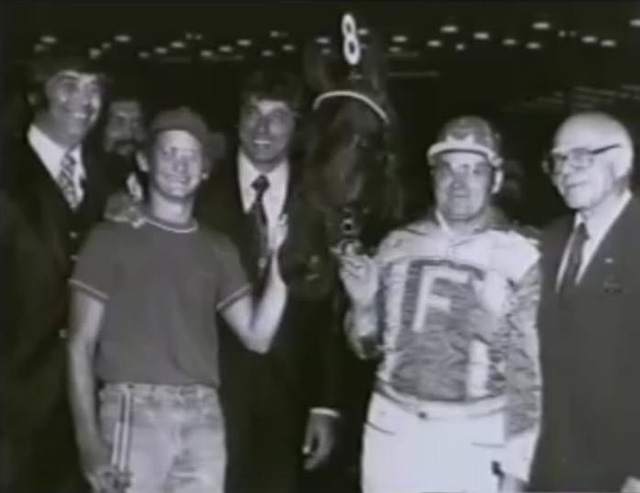
How many people can you recognize in this photo taken at The Meadowlands? Clue: not everyone was directly connected with harness racing.
Who Else Is It?
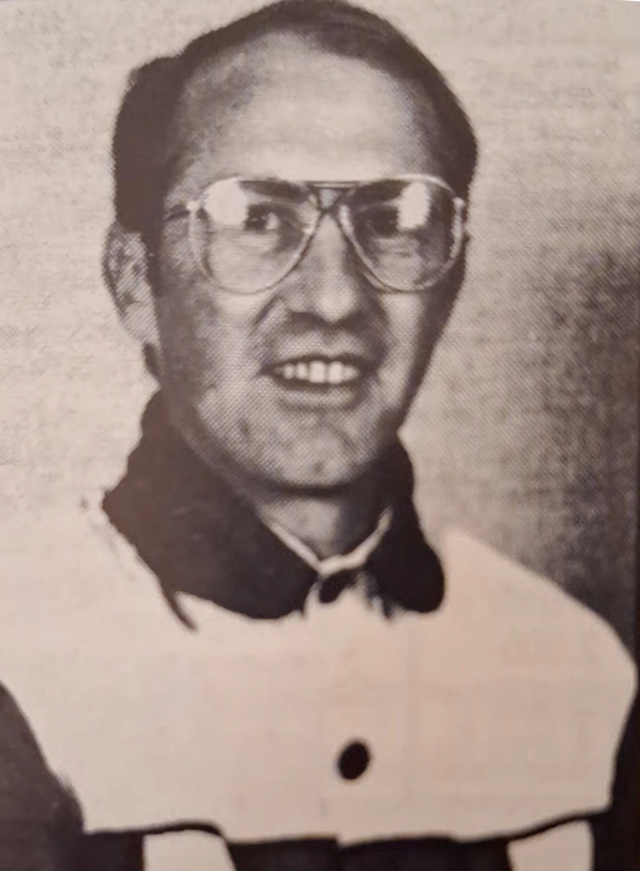
Who is this young lad? Name him if you can.
Blast From the Past
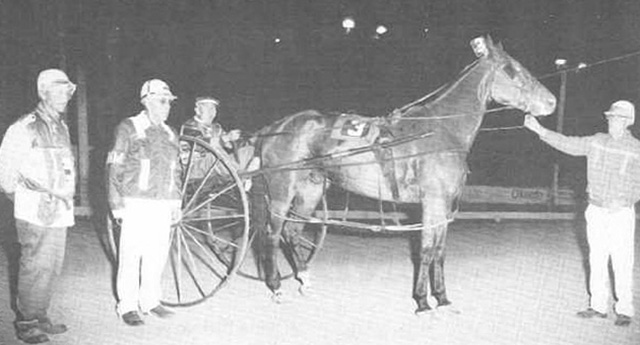
This old photo was taken many years ago at Hanover Raceway in Hanover, Ont. It was a special night arranged to recognize some of the local pioneering horsepeople who had contributed to the start-up of nighttime harness racing in that area. Can you identify any of them?
(The correct answers will be posted here by Robert as a comment in a few days.)
This week's picture & Quiz answers
Our experts continue on a streak. The correct answers to the photos and mini quiz were as follows:
Farrington trivia question - Looks like everybody knew about Bob Farrington's talent as a brick mason aka bricklayer.
The Who is it? photo was L-R - Joe Defrank Race Sec'y at the Meadowlands, Smiling groom (not certain? ), "Broadway Joe " Namath football star, Rambling Willie, Bob Farrington, and David "Sonny " Werblin representing The Meadowlands.
The Who else photo was our own Larry Walker, a member of a great Ontario racing family.
In the Blast From the Past: Elmer Fritz, Hugh McLean, Jacob Geisel in the sulky and Frank Carnahan.
Thanks to all of you!
Bob Farrington was a brick layer
Bob Farrington was a brick layer
Trivia Question: Brick Mason…
Trivia Question: Brick Mason.
Who Is It? Joe DeFrank, caretaker Mike Martin, Joe Namath, horse is Rambling Willie, Robert Farrington and David “Sonny” Werblin.
Who Else Is It? Maybe Larry Walker?
Blast From the Past: Elmer Fritz, Hugh McLean, Jacob Geisel in the sulky and Frank Carnahan.
Who is it
(1) L to R: Joe DeFrank, Joe Namath, Bob Farrington and Sonny Werblin.
(2) Larry Walker.
Who is it?Ramblin willy,…
Who is it?
Ramblin willy, brad farington, Joe Montana Nick name shut up Joe, race secretary Joe Defrank, groom shaky lou
Who else is it?
Larry walker
Blast from the past...
Who is it Bob Farrington …
Who is it Bob Farrington Who else is it Larry Walker Blast from the past Elmer Fritz Hughie McLean Jacob Geisel driver Frank Carnahan holding the horse Farrington Trivia Question He was a brick mason